

32 min
0
01.14.2025

Creating a table of contents for a research paper is essential for structuring and organizing your document. Acting as a roadmap, it provides readers with a clear overview of sections, subsections, and topics, making navigation seamless. A well-structured table of contents example for research paper enhances readability and reflects a professional touch, which is crucial for academic or scientific work. This article delves into what a ToC is, how to create one step-by-step, and common mistakes to avoid. We also explore its variations, formatting tips, and tools like Microsoft Word. By the end, you'll know exactly how to create a table of contents for research paper tailored to your needs. If you need professional assistance in structuring your research paper, check out our research paper help service.
What’s a Table of Contents (ToC)?
A table of contents in a research paper is an organized list that outlines sections, chapters, and subsections, alongside their corresponding page numbers. It serves as a guide for readers, allowing them to locate specific parts of the paper quickly. When preparing a table of contents essay example, ensure it includes all major sections, such as the introduction, body paragraphs with subtopics, and the conclusion, to guide readers seamlessly through the essay's structure.
Key elements of a ToC include:
- Headings and subheadings: These represent the main chapters and detailed subsections.
- Page numbers: Indicate where each section begins, ensuring clarity.
ToCs are particularly important in academic and scientific writing, such as dissertations or term papers, as they showcase the document's structure and depth. A clear, concise ToC helps maintain the reader's focus and provides a professional appearance.
If you're struggling to structure your research paper, our write my research paper service can help you create a well-organized document with a professional Table of Contents.
Downloadable Examples - https://docs.google.com/document/d/17prS6axLXpOSVR7qnUvONf_GkUDz2jyO/edit
How to Structure a Table of Contents
The structure of a table of contents academic paper should follow a hierarchical format to ensure clarity. Here's a breakdown:
|
Level |
Description |
|---|---|
|
Heading 1 |
Major sections like Introduction, Methods, Results. |
|
Heading 2 |
Subsections, e.g., "Data Collection" under Methods. |
|
Heading 3 |
Detailed points, e.g., "Survey Design." |
Key Guidelines for Structuring:
- Title Placement: Begin with a bold, centered title like Table of Contents. Ensure it is visually distinct from the rest of the text.
- Consistent Formatting: Use consistent font styles and sizes for headings. For example, Heading 1 might be bold and larger, Heading 2 italicized, and Heading 3 indented.
- Alignment and Spacing: Align all headings to the left and page numbers neatly to the right margin using dot leaders for readability. Maintain uniform spacing between entries.
- Include Page Numbers: Ensure accuracy by cross-checking page numbers with the actual document to avoid discrepancies.
- Logical Flow: Follow the natural order of your document’s sections to ensure intuitive navigation for readers.
- Hierarchy: Maintain a clear hierarchical structure in the ToC, listing main sections first, followed by their respective subsections. This structure allows readers to easily understand the organization of the manuscript.
- Accuracy: Ensure that all entries in the ToC correspond exactly to the sections and subsections in the document. Avoid adding minor headings or unnecessary references that do not significantly contribute to the document’s organization.
This hierarchy ensures the table of contents for term paper is intuitive and user-friendly, highlighting key parts while maintaining a professional appearance.
Types of Table of Contents
Creating a ToC for a research paper requires a clear structure and attention to detail. There are several variations of ToCs, depending on the document's purpose and complexity.
Tips for Choosing the Right Type of ToC
The aim, length, and complexity of your research paper will determine which form of ToC (Table of Contents) to use. Here's how you decide:
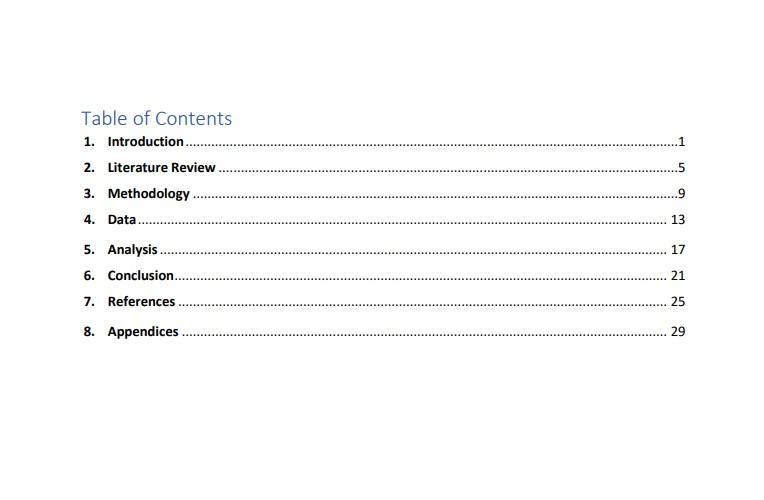
Simple ToC
Includes only major sections like Abstract, Introduction, and Conclusion.
When to Use:
- Best for short research papers, essays, or assignments with fewer sections.
- Ideal when the content is straightforward and doesn’t require in-depth navigation.
Why:
- It keeps the structure uncluttered, ensuring quick access to major sections.
- Avoids overwhelming readers with excessive details in a concise document.
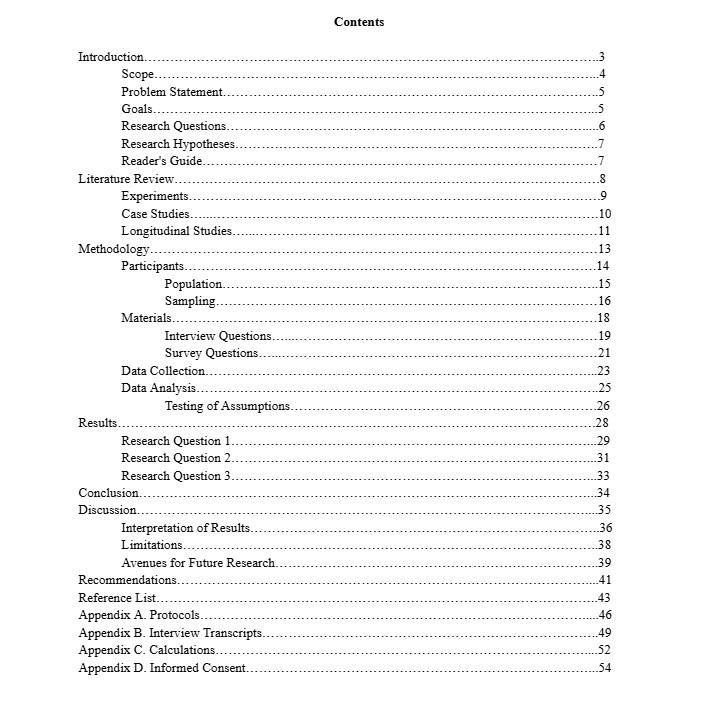
Detailed ToC
Includes chapters, subsections, and minor topics.
When to Use:
- Essential for longer research papers, dissertations, or theses.
- Suitable when there are multiple chapters, subsections, or appendices.
Why:
- Provides detailed navigation, allowing readers to locate specific topics easily.
- Enhances the professional appearance of comprehensive academic works.
Numeric ToC
Follows a strict numbering system for all sections and subsections.
When to Use:
- Required for documents adhering to formal academic or journal guidelines (e.g., MLA or APA style documents).
- Useful in systematic research papers or reports with a clear hierarchical structure.
Why:
- A numbering system offers clarity and consistency, especially in multi-author works.
It aligns with standardized formatting rules, making the paper publication-ready.
Custom ToC
Tailored to specific guidelines or unique formats.
When to Use:
- Suitable for creative projects, interdisciplinary studies, or when following specific institutional requirements or working on a non-traditional assignment.
- Works well for unique formats like portfolios or multimedia presentations.
Why:
- Flexibility allows for tailoring the ToC to non-traditional or experimental document structures.
- Helps highlight innovative approaches or non-linear research narratives.
Understanding these types helps determine the best approach for your document, ensuring relevance and professionalism.
Additional Considerations
- Audience: If the paper targets a general audience, simplicity is better. For academic peers, a detailed or numeric approach ensures credibility.
- Length: Short papers benefit from simple or numeric ToCs, while detailed or custom ToCs suit longer, complex works.
- Guidelines: Always consult institutional or publisher requirements before selecting a ToC type, as specific formats might be mandated. By aligning the ToC type with your document’s objectives and complexity, you create a professional and reader-friendly guide to your research.
How to Write a Table of Contents for a Research Paper Step by Step
Understanding how to write a ToC for a research paper involves organizing major sections, aligning page numbers, and formatting headings to create a professional and accessible layout for readers.
A well-organized ToC enhances readability by outlining sections and subsections with proper formatting and page numbers.
1. Identify Main Sections
Start by outlining the primary sections of your paper. These often include:
-
Abstract
-
Introduction
-
Methods
-
Results
-
Discussion
-
Conclusion
2. Add Subsections
Under each major section, include relevant subsections that help detail the structure. For instance: Under "Methods," you might add subsections like Data Collection and Analysis Methods. Under "Results," you could include specific findings or experiments.
3. Format with Consistency
Use heading styles (Heading 1, Heading 2) in Microsoft Word or other tools to maintain uniformity. Ensure page numbers are aligned properly.
4. Include Visual Elements
In a research paper, visual components such as tables, figures, and appendices are quite important in improving the grasp of difficult facts. Although they are not central to the story, they frequently offer necessary extra information. Separate ToC sections should contain references to various components in order to increase reader access.
Why Include Visual Elements in the ToC?
- Ease of Navigation: Readers can quickly locate critical visual aids without searching through the entire document.
- Professionalism: A dedicated section for visual elements demonstrates thoroughness and attention to detail.
- Relevance: Helps highlight additional resources that support your findings or arguments.
How to Add Visual Elements to the ToC
- Create a List of Tables: Include the titles of all tables along with their corresponding page numbers. For example, "Table 1: Summary of Results - Page 12."
- Create a List of Figures: List figures with descriptive titles and page numbers, such as "Figure 2: Graph of Population Growth - Page 15."
- Include an Appendices Section: Appendices should be treated as distinct sections in the ToC, with titles like "Appendix A: Survey Questionnaire - Page 25."
Formatting Tips for Visual Elements in the ToC
Use a consistent format for numbering and titles (e.g., Table 1, Figure 1). Ensure alignment and indentation match the main sections and subsections in the ToC. Place these lists after the main body sections in the document, but before any bibliographies or references.
By including visual elements in the ToC, you enhance the usability of your research paper, making it easier for readers to locate and interpret supplementary data that supports your work.
5. Refine for Simplicity
Avoid overcrowding your ToC. Focus on clarity by prioritizing major sections and essential subsections. Readers should be able to scan it and immediately understand the paper’s layout.
By following these steps, you can confidently create a clear and functional ToC for the research paper.
Want to speed up the writing process? Check out our step-by-step guide on how to write a research paper fast for expert tips and time-saving techniques.
What Not to Include in Your Table of Contents
While a ToC should cover all major parts of a document, avoid these common mistakes:
- Dedication and Acknowledgments: These are not part of the research structure.
- Minor Subsections: Avoid overloading with unnecessary details.
Keeping your ToC focused ensures it remains professional and easy to navigate for readers.
Should Lists of Tables and Figures Be Included in the ToC?
The inclusion of Lists of Tables and Figures in a research paper's ToC depends on the specific guidelines provided by the institution, journal, or academic style you are following (e.g., APA, MLA, Chicago). However, here are general guidelines to help you decide:
When to Include Lists of Tables and Figures in the ToC
- Long and Detailed Papers: If your research paper has a substantial number of tables and figures, it’s useful to include a "List of Tables" and "List of Figures" in the ToC to improve navigation.
- Institutional or Journal Requirements: Some academic institutions or journals mandate including these lists in the ToC for comprehensive referencing.
- Dissertations and Theses: Lists of Tables and Figures are typically included in the ToC for formal academic submissions like dissertations or theses.
When Not to Include Lists of Tables and Figures in the ToC
- Shorter Research Papers or Essays: For concise papers, where there are only a few tables or figures, dedicating sections to these lists may not be necessary.
- Style-Specific Rules: Some formats, like MLA or certain journal-specific styles, might not require these lists to appear in the ToC.
How to Make a Table of Contents for a Research Paper in Microsoft Word
To understand how to make a ToC for a research paper in Word, start by outlining all main sections, applying consistent heading levels. Here is a step by step guide on how to use automated tools in Microsoft word to format and align page numbers accurately.
- Open your document in Microsoft Word.
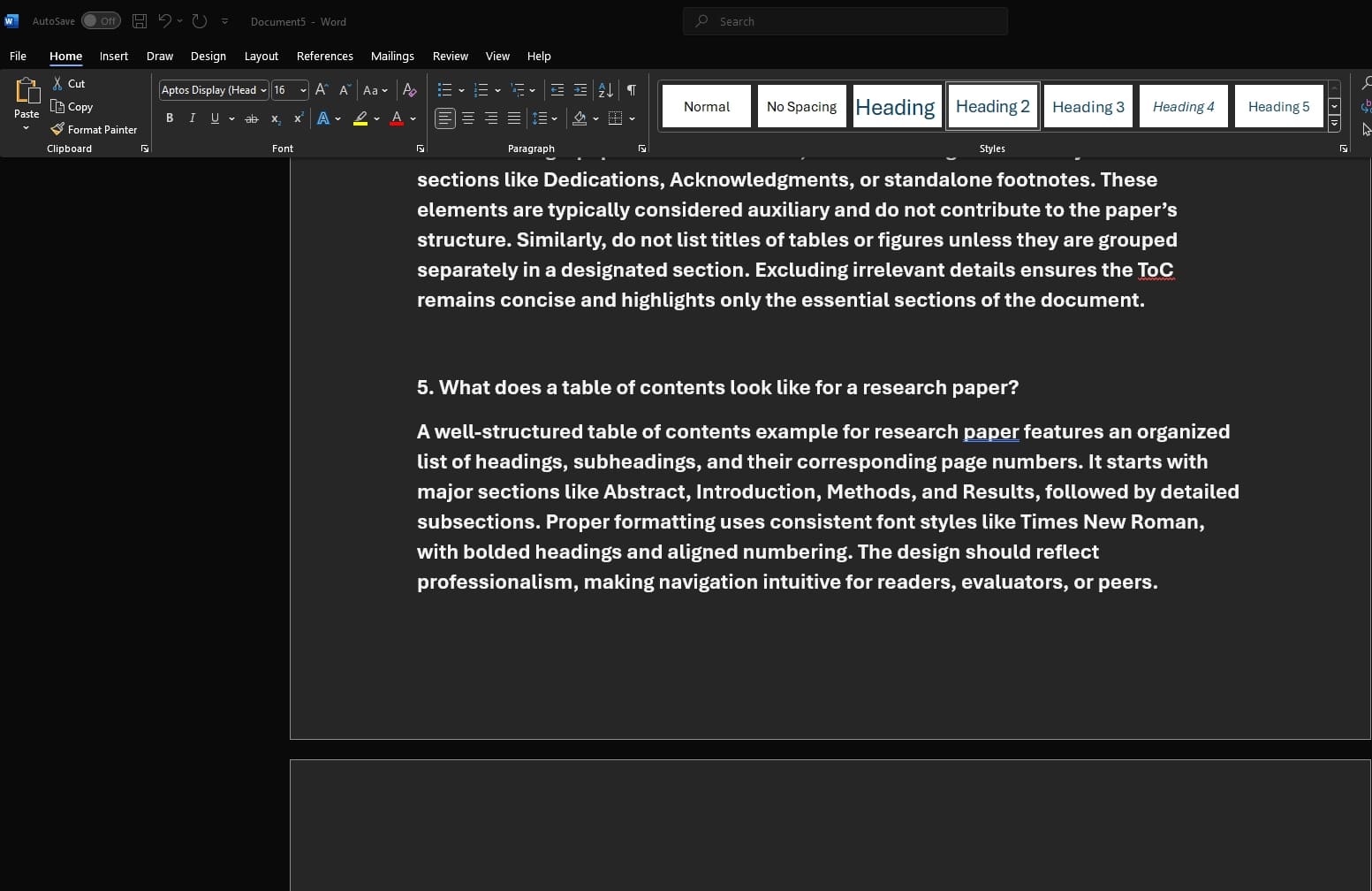
Ensure your paper is complete and that all sections are clearly labeled with appropriate headings.
- Go to the "References" tab.
Click on the "Table of Contents" option to view pre-designed templates.

- Choose a style that fits your document.
Select a ToC style that suits your document's purpose and formatting requirements. Academic papers typically benefit from simple and formal styles.
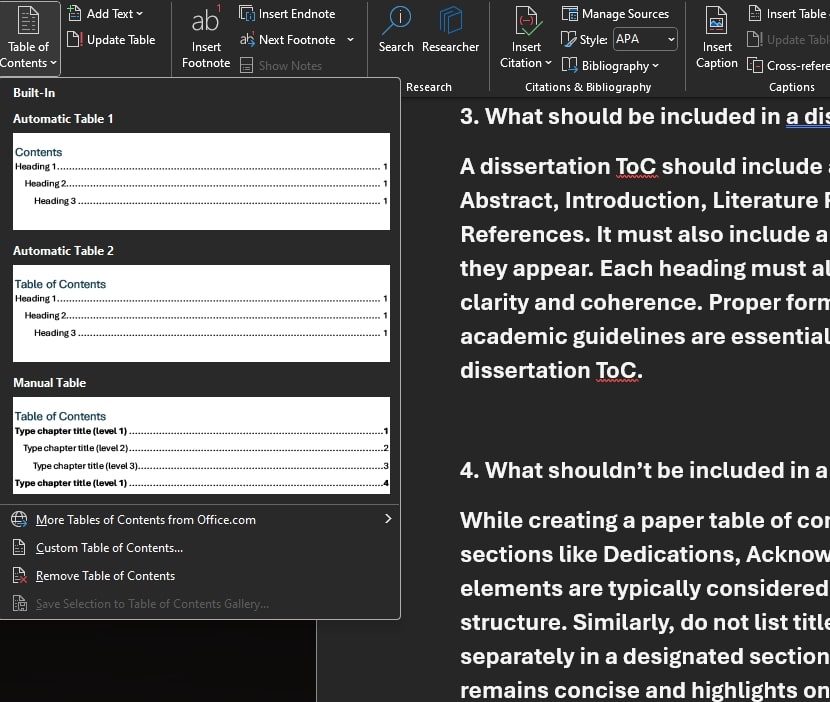
- Assign proper headings (Heading 1, Heading 2) to your content.
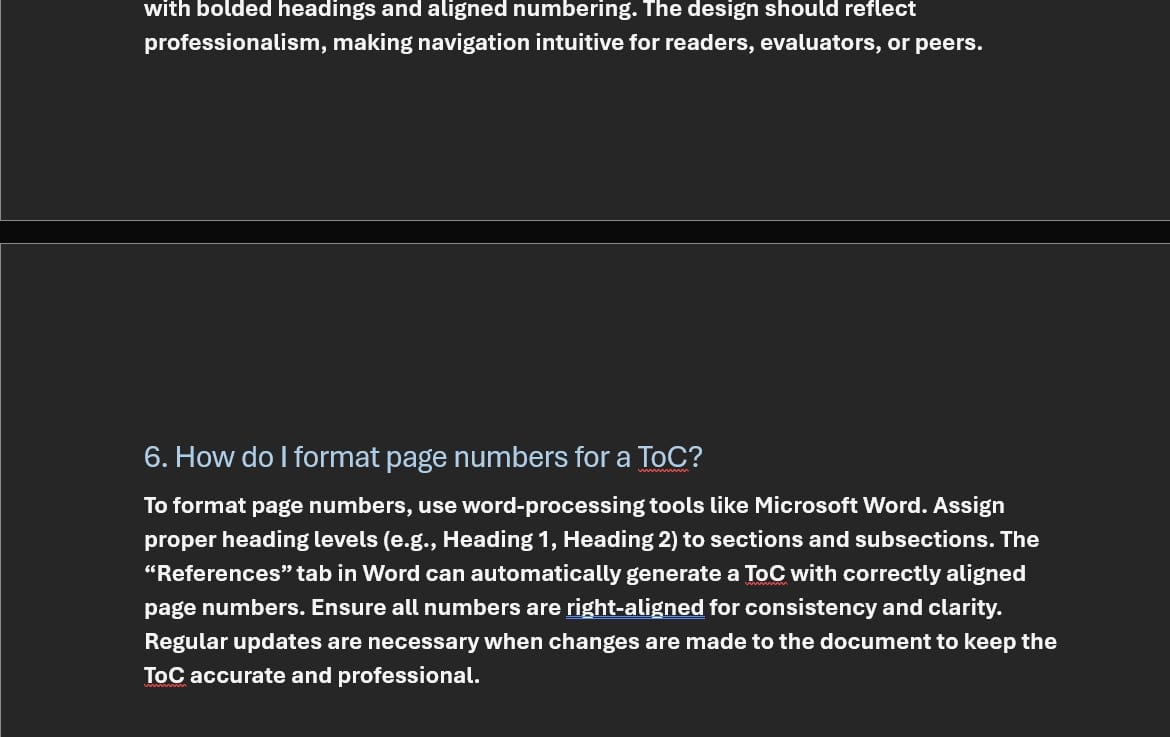
- Update the ToC dynamically as the document changes.
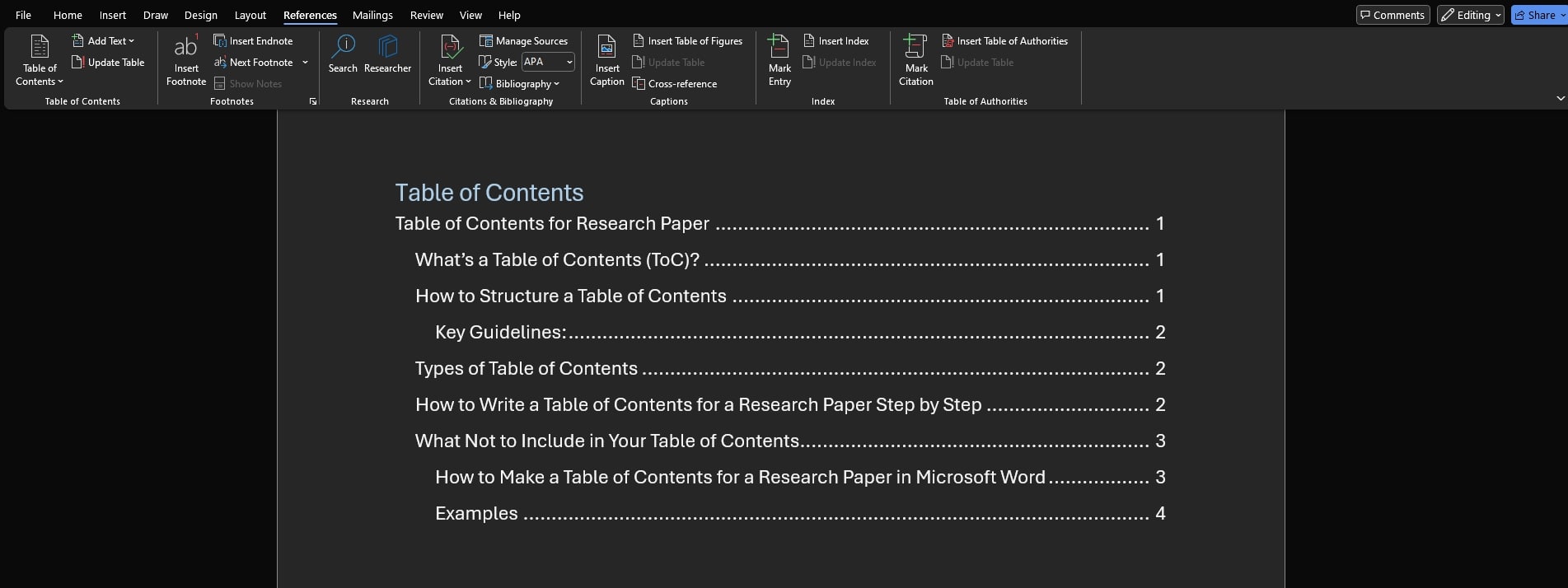
With Microsoft Word, formatting and updating a ToC is seamless, making it a preferred tool for academic writers. When deciding where to put table of contents in research paper, it should typically be placed after the Abstract and before the Introduction to provide readers with a clear roadmap of the document's structure.
Pro Tip:
When using Word, you can format the page numbers and align them consistently by customizing the inserted ToC. Adjust indentation for subsections to enhance readability.
When to Place the Table of Contents in a Research Paper
The ToC should be positioned strategically to maximize its usefulness:
- After the Abstract: This ensures readers have immediate access to the document’s structure.
- Before the Introduction: This placement provides a clear roadmap before diving into the content.
Experts recommend that students ensure each subsection is properly formatted with consistent styles, such as using "Level 1" headings for main sections to maintain clarity and professionalism in their documents.
Examples
Learning how to make table of contents for research paper involves structuring major sections, ensuring clear formatting, and using tools like Microsoft Word to align headings and page numbers for a polished, professional look.
Here are some examples of well-structured ToCs:
- Simple ToC Example
- Detailed ToC Example
- Numeric ToC Example
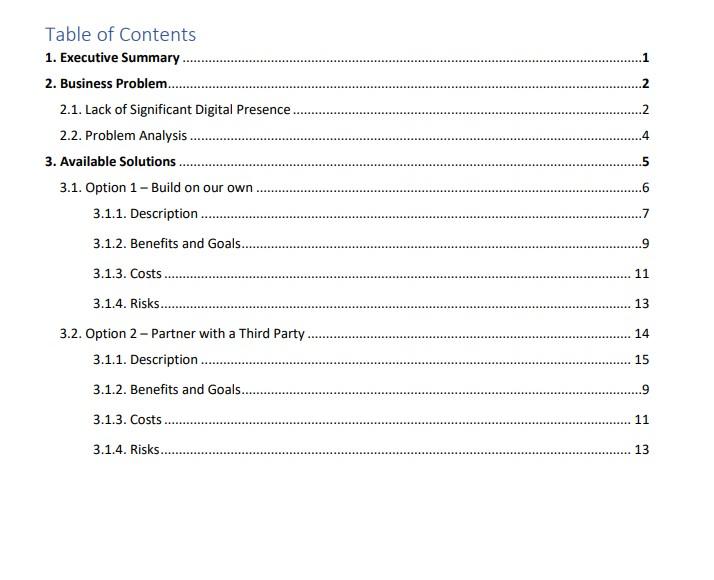
These examples provide visual clarity on how to organize sections, headings, and page numbers effectively. If you find yourself struggling with this process, you can always pay someone to write a research paper to ensure it’s done professionally and according to the required format.