
20 min
0
09.11.2025
Key Takeaways
- It doesn't have to be hard to choose the perfect nursing school. You may confidently choose a program that fits your academic ambitions, lifestyle, and long-term career path, provided you have the correct information and know what you value most. Here are a few important things to remember, whether you're looking at NCLEX stats, learning about biology, or looking into online options:
- Think about your goals first. Are you looking for a school for clinical practice, research, or public health? Let your future route drive your search.
- Don't only look at the rankings; also pay particular attention to the NCLEX pass rates, the support from instructors, and the chances to get real-world experience.
- Look into financial aid early on. There are more ways to get money than you might think, from FAFSA to research grants.
- If you can, go to the campus and meet current students. Nothing beats that.
- Stay curious; exceptional nurses never stop learning, and the proper school will encourage that from the start.
- Key Takeaways
- 1. The Best Nursing Schools in the US: Rankings, Paths, and How to Pick One
- 2. How to Pick the Best Nursing School for You
- 3. The Best 25 Nursing Schools in the U.S.
- 4. Comparing BSN, MSN, and DNP Programs
- 5. The Best Nursing Schools for Students from Other Countries
- 6. What Is a Good Score on the NCLEX?
- 7. Nursing Grants, Scholarships, and Financial Aid
- 8. Life as a Student at the Best Nursing Schools
- 9. Pros and Cons of Online and On-Campus Nursing Programs
- 10. The Best States for Nursing Jobs After College
- 11. Things to Ask When You Visit a Nursing School
- 13. Questions and Answers
1. The Best Nursing Schools in the US: Rankings, Paths, and How to Pick One
You're not alone if you're thinking about becoming a nurse, and there's a solid reason for it. According to the Bureau of Labor Statistics, nursing will rise by 6% over the next ten years, with more than 193,000 openings for registered nurses each year. Nursing is more than simply a secure employment; it also integrates directly with some of the most interesting and important disciplines of study, such as patient psychology, public health, and even biological research issues. Nursing gives you the tools to explore and address real-world problems, whether you're interested in how viruses function in the human body or how environmental factors affect health outcomes.
The first step on this lucrative route is to pick the right nursing school. But there are hundreds of authorized programs in the U.S. How can you determine which one is best for you? There are many different programs to choose from, from Ivy League schools to state universities with state-of-the-art simulation labs. The best one for you will depend on your goals, money, and how you study best. In the next sections, we'll talk about what constitutes a good nursing school, how to compare your alternatives, and which programs always come out on top.
2. How to Pick the Best Nursing School for You
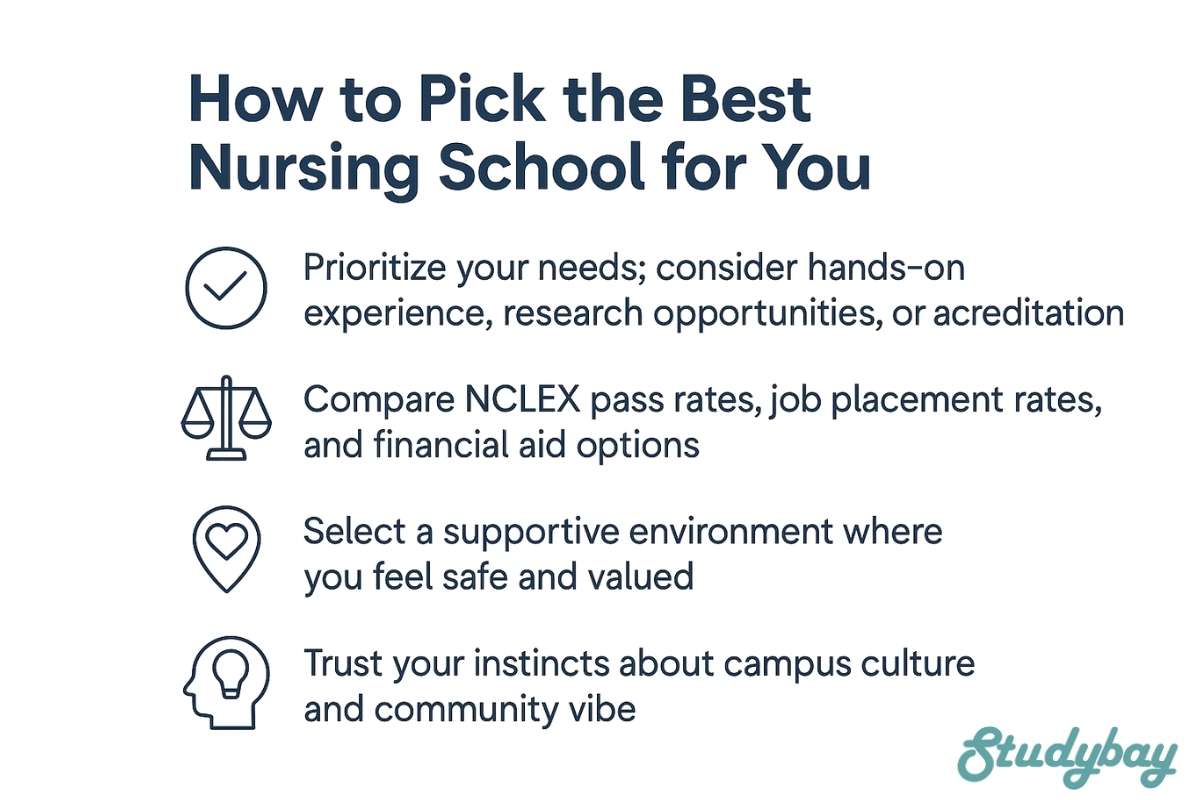
Picking a nursing school can be hard. It's easy to get lost in a sea of pamphlets and rating charts when there are so many choices, programs, and prices. The truth is, the "best" school isn't the one with the coolest campus or the most social media hype. It's the one that matches you, your learning style, your objectives, your budget, and your aspirations for the future in health care.
To begin, limit down your options depending on what is most important to you. Do you want to get some hands-on experience right away? Find programs that have good ties with clinics or labs for simulations. Want to do health research or become a nurse educator someday? Then look at the kinds of biology projects that college students do, such as looking at how medicines affect different body systems or how infectious diseases spread. It's also vital to look at things like accreditation, NCLEX pass rates, and job placement rates. And don't forget to look at financial aid options. The most costly school isn't always the best choice.
Most importantly, pick a school where you feel safe. The greatest programs don't simply help you do well in school; they also help you do well in life and at work. Listen to your gut when it comes to choosing between a big city research institution and a small college with a close-knit community. This isn't just about getting a degree; it's about laying the groundwork for the nurse you want to be.
3. The Best 25 Nursing Schools in the U.S.
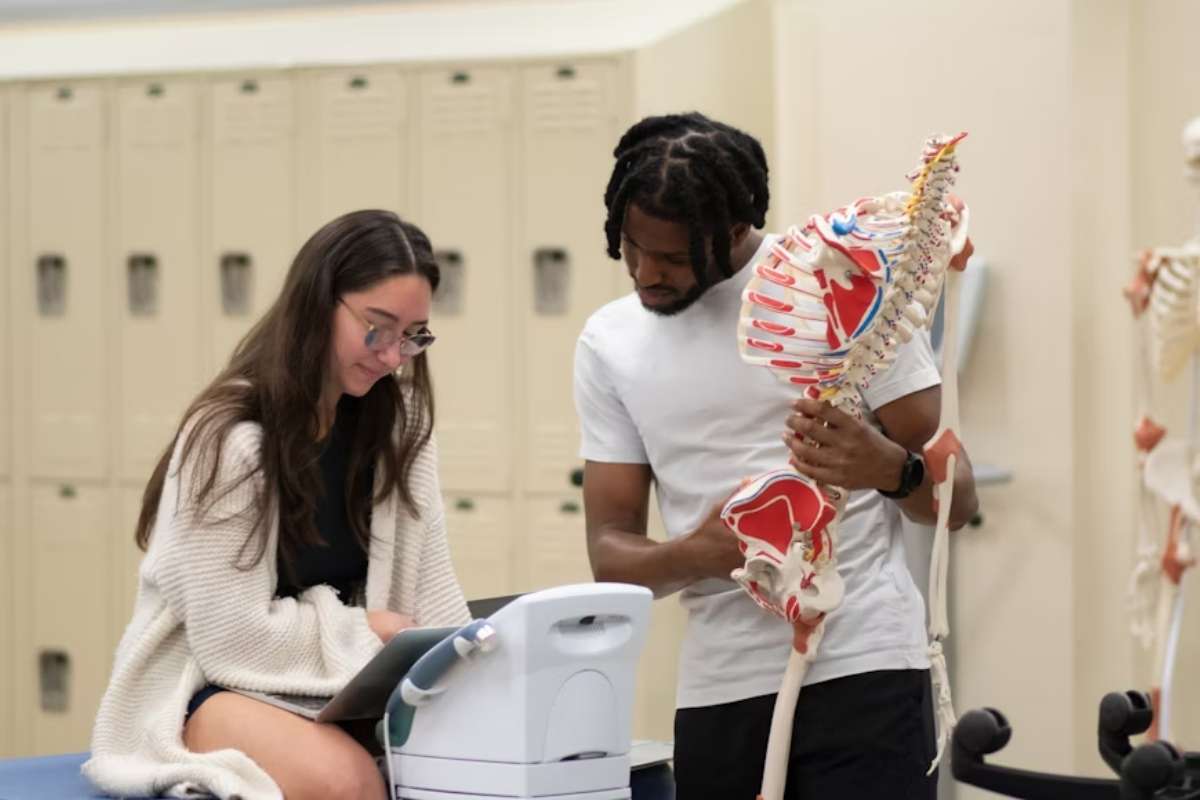
Not all nursing schools are the same, and if you care about your future, it's important to know which ones are the best. The best schools do more than just teach in the classroom. They also have high NCLEX pass rates, solid clinical relationships, competent instructors, and chances to do advanced research. If you want to study biological issues like the genetics of disease, how the immune system works, or how to analyze patient data, the proper program can provide you access to labs and research mentors early on in your studies.
Here are 25 of the best nursing schools in the U.S. based on public rankings from Niche, U.S. News, QS, and other data like graduation rates and job placement rates:
- Texas West Coast University (Richardson, TX)
- Durham, North Carolina: Duke University
- Houston, TX: Chamberlain University
- West Coast University in Miami (Doral, FL)
- University of Pennsylvania in Philadelphia, PA
- Stanbridge University in Orange County (Irvine, CA)
- University of Texas at Tyler in Tyler, Texas
- Joyce University of Nursing and Health Sciences is in Draper, Utah.
- Los Angeles, California, is home to West Coast University (North Hollywood, CA).
- New York University (NY)
- Tempe, Arizona College of Nursing
- Emory University in Atlanta, Georgia
- Grand Canyon University is in Phoenix, Arizona.
- West Coast University in Ontario, California
- University of Miami in Coral Gables, Florida
- Nevada State University in Henderson, NV
- South College in Knoxville, Tennessee
- University of Texas at Arlington (Arlington, TX)
- Ann Arbor, Michigan, is home to the University of Michigan.
- Western Governors University (on the web)
- Louisville's Galen College of Nursing (Louisville, KY)
- Nebraska Methodist College of Nursing and Allied Health in Omaha, NE
- Ohio University, Athens, OH
- Molloy University is in Rockville Center, New York.
- Azusa Pacific University is in Azusa, California.
Let's take a deeper look at the three best schools that are at the forefront of current nursing education:
3.1 The University of Pennsylvania
Penn Nursing is an Ivy League institution that combines status with real-world performance. Students benefit from having access to state-of-the-art simulation labs, top-notch hospitals, and a curriculum that focuses on leadership, policy, and hands-on learning. This curriculum gets you ready to lead, whether you want to work in genetics, public health, or advanced clinical practice.
3.2 University of Michigan—Ann Arbor
UMich is known for its excellent doctoral programs and strong focus on global research, which makes for a lively learning atmosphere. Students learn by working with data, doing community health projects, and working together across professions like bioinformatics and healthcare ecosystems. It's a school that focuses on research and is great for pupils that want to do well in school.
3.3 Duke University
Duke's nursing school is great for training in community health and elder care because it has a unique curriculum that combines research with caring. Students work with people who don't get enough care and learn how to deal with genuine health problems, such as those caused by germs, chronic diseases, and getting to the doctor. They also get help from renowned doctors and researchers.
4. Comparing BSN, MSN, and DNP Programs
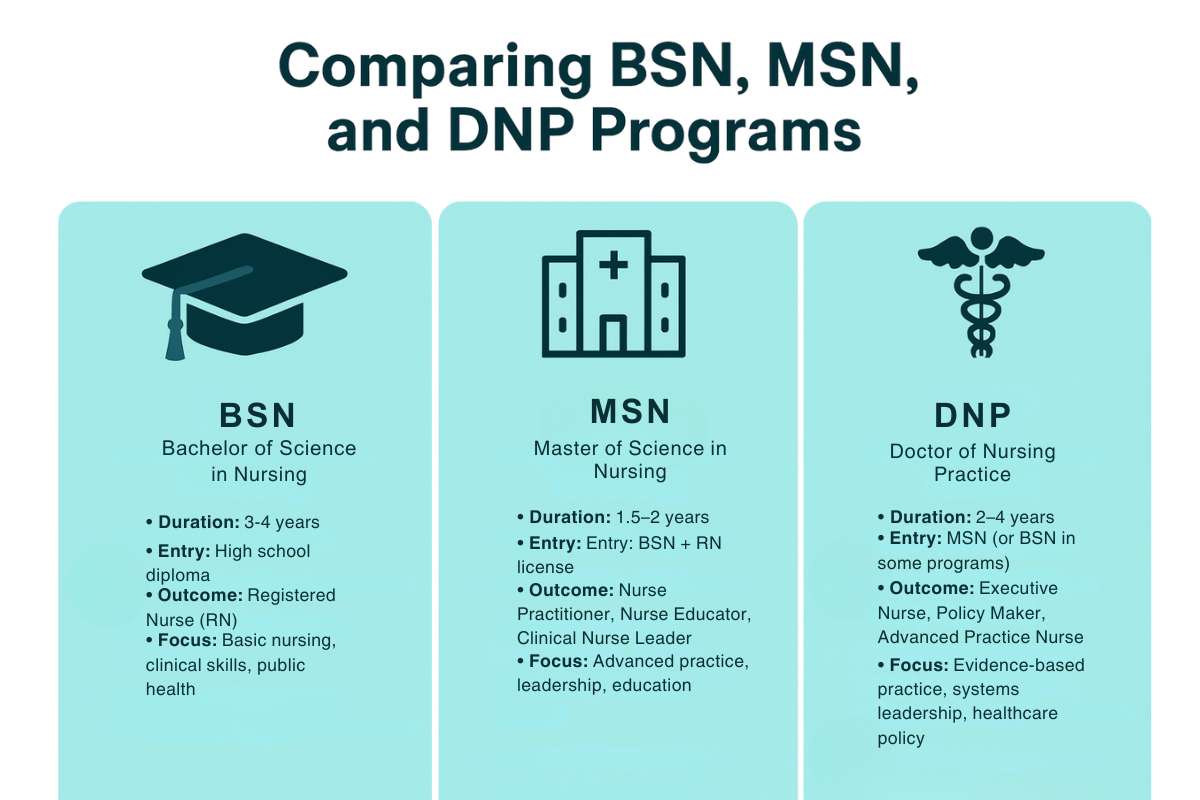
It's a good thing that not all nursing degrees lead to the same job. There is a degree that will help you reach your goals, whether you are just starting out or want to be a nursing leader. To plan your future, you need to know the difference between a BSN (Bachelor of Science in Nursing), MSN (Master of Science in Nursing), and DNP (Doctor of Nursing Practice).
At the BSN level, you'll learn the basics of anatomy, pharmacology, patient care, and public health. This will give you a strong base for clinical practice or more study. As you continue on to graduate programs like the MSN or DNP, you'll start to learn about leadership, health policy, advanced clinical skills, and even more specialized topics in biology like genetics, immunology, and modeling chronic diseases. With these higher degrees, you can also do research, teach, or work as a nurse practitioner or clinical educator.
A BSN is frequently enough to start if you want to work directly with patients and have opportunities to improve. But an MSN or DNP can help you shape the future of healthcare through research, teaching, or advanced practice. It's less about how prestigious the degree is and more about how well it fits with the difference you want to make.
Comparing BSN, MSN, and DNP Programs
| Feature | Bachelor of Science in Nursing (BSN) | MSN (Master of Science in Nursing) | Doctor of Nursing Practice (DNP) |
|---|---|---|---|
| How Long It Usually Lasts | Three to four years | 1.5–2 years | 2 to 4 years |
| Who can apply | A high school diploma or something like it | A BSN degree and a license to be an RN | MSN degree (or BSN in some BSN-to-DNP programs) |
| What Happens After You Graduate | Registered nurse (RN), staff nurse, and care coordinator | Nurse Educator, Nurse Practitioner, Clinical Nurse Leader | Executive Nurse, Policy Maker, and Advanced Practice Nurse |
| Main Areas of Focus | Basic nursing, clinical skills, and public health | Advanced practice, leadership, education, and biological themes | Evidence-based practice, leading systems, and making healthcare policy |
| Chance to do research | Introductory classes or electives | Thesis or capstone project with a specific focus | Applied research or quality improvement at the dissertation level |
| Common Places of Work | Long-term care facilities, hospitals, and clinics | Specialty clinics, schools, and leadership positions | Hospitals, schools, healthcare systems, and government agencies |
| Getting a license | Gets ready for the NCLEX-RN | Could lead to becoming an NP, CNS, or something else. | DNP is the highest level of clinical degree and goes along with board certification. |
5. The Best Nursing Schools for Students from Other Countries
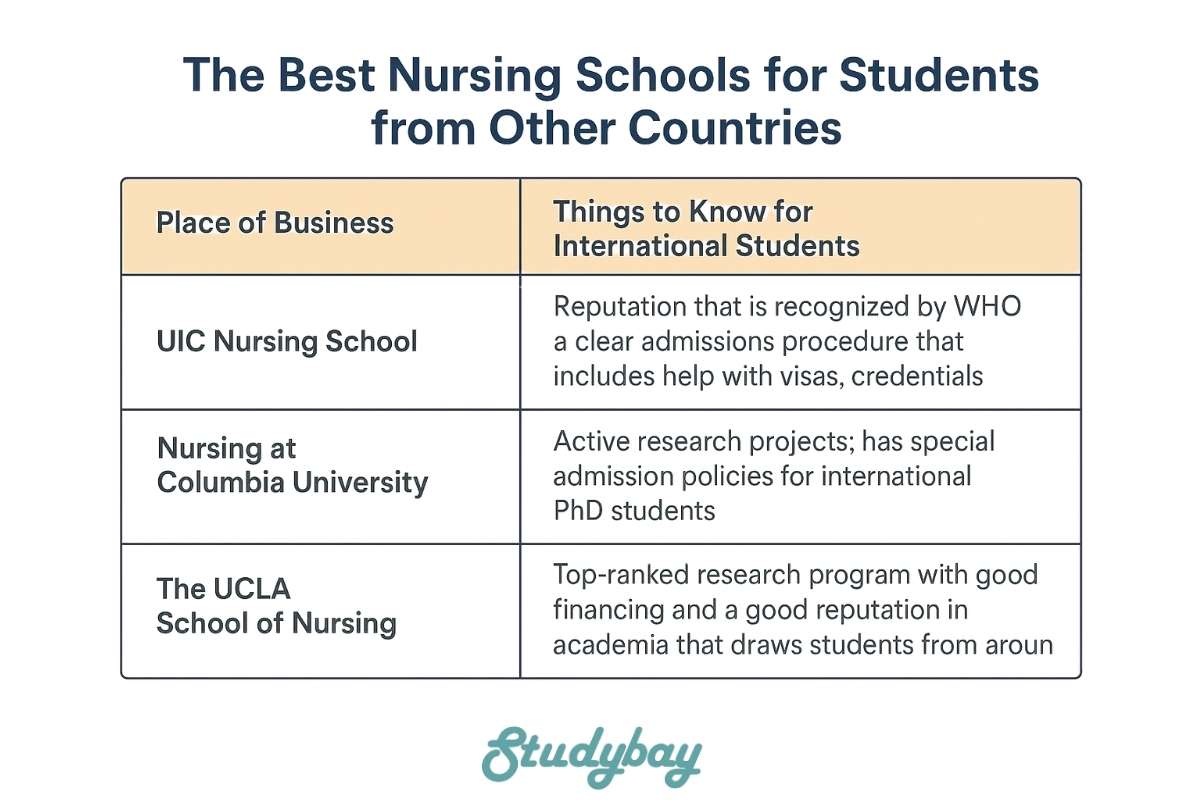
If you are an international student who wants to work as a nurse in the U.S., you are not alone. In fact, there are a lot of jobs available. Not only are American institutions admitting more and more international students, but many of the best nursing programs are also making their degrees more useful for students from other countries.
These schools provide help with visas and offer global scholarships. They also give students the chance to do important biology research on themes like infectious illnesses, vaccine development, and community health. For a lot of overseas students, it's a chance to combine academic research with making a difference in the real world, all while getting a degree that is respected around the world.
The Best Nursing Schools for Students from Other Countries
| Place of Business | Things to Know for International Students |
|---|---|
| UIC Nursing School | Reputation that is recognized by WHO; a clear admissions procedure that includes help with visas, credentials, and money |
| Nursing at Columbia University | Active research projects; has special admission policies for international PhD students |
| The UCLA School of Nursing | Top-ranked research program with good financing and a good reputation in academia that draws students from around the world |
6. What Is a Good Score on the NCLEX?
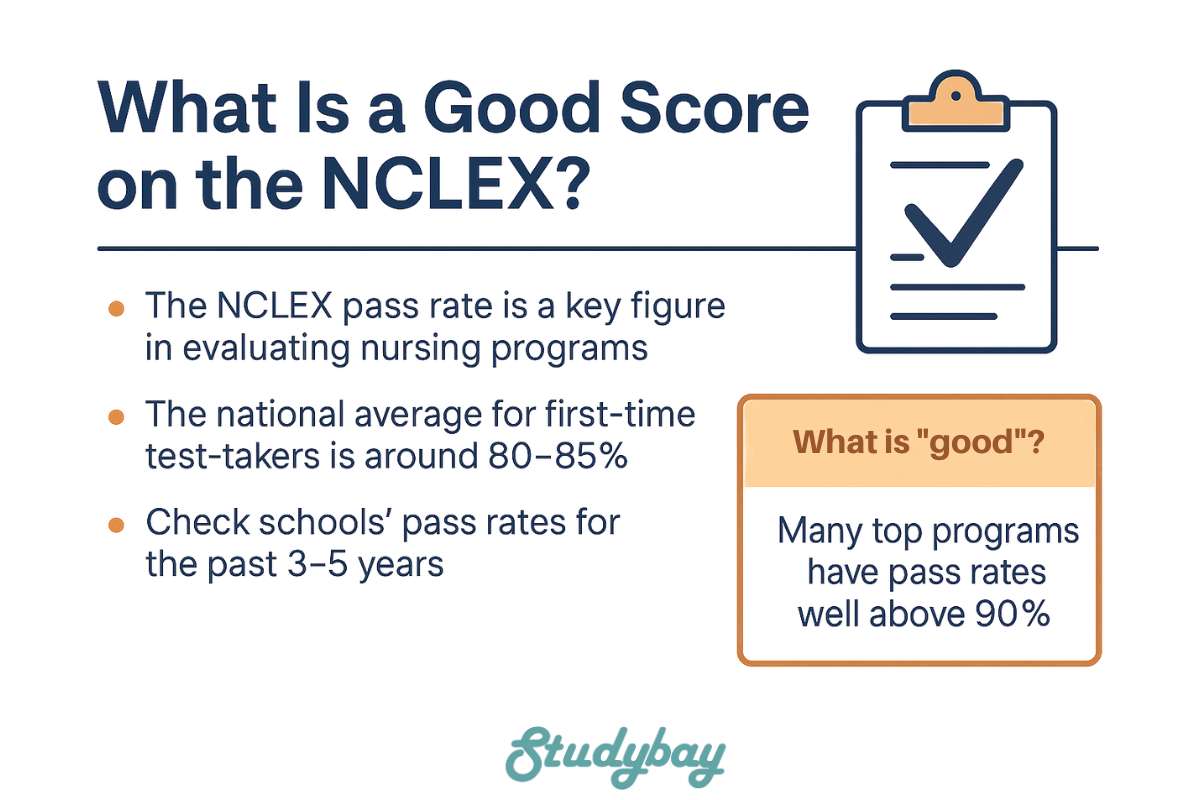
The NCLEX pass rate is one of the most important numbers to look at when comparing nursing programs. All people who want to be registered nurses in the U.S. must pass the NCLEX (National Council Licensure Examination), which is a standardized test. A school is setting its kids up for success if it has a strong curriculum, experienced teachers, and good test prep support, all of which are indicative of a high pass rate.
So what does "good" mean? The national average for first-time NCLEX test-takers is roughly 80–85%, while many of the best programs have rates that are much above 90%. When looking at schools, check their stated pass rates from the last 3–5 years and ask how they get students ready for tests. Do they use mock exams, clinicals, or even integrated biology project ideas that help students really comprehend how body systems work and how diseases spread? The more a program teaches you how things work, the better you'll be able to pass the NCLEX and start your nursing profession with confidence.
7. Nursing Grants, Scholarships, and Financial Aid

Nursing school costs a lot of money. The good news is that there are many methods to make up for the cost if you know where to go. There are a lot of ways to get financial aid that aren't only based on need. They can also be based on merit, identity, or even your academic interests. If you want to study biological areas like microbiology, pharmacology, or immunology, you might be able to get a research assistantship or a STEM-based scholarship. Some nursing schools even give students extra money if they want to go on to work in research or academics.
The FAFSA is the first step. It will help you get most government aid, like Pell Grants and loans with low interest rates. After that, check out state-based nursing scholarships and awards from the schools you're applying to. Some institutions give full-tuition nursing grants, while others give stipends to people who want to work in high-need clinical specialties. Check the deadlines, which are usually between October and March, and get in touch with the financial aid office at each institution for help that is specific to you. Making smart choices about money today can have a big impact later.
8. Life as a Student at the Best Nursing Schools

Being a nursing student isn't only about going to labs and working at the hospital; it's also about finding a routine that works for you. Students at the best nursing schools learn about biology in a lot of different ways, including through classes, study groups led by other students, undergraduate research clubs, and even health sciences activities on campus. The academic environment is meant to keep your curiosity alive, whether you're looking at case studies of disease outbreaks or debating public health policy with your classmates. But there's still time for dorm life, campus dining, and the occasional nap between shifts.
That said, nursing school may be stressful. That's why the finest programs put a lot of money into student health and wellness. A lot of them have therapy for mental health, gyms, tutoring centers, and clubs for people of different backgrounds to help them feel like they belong. Housing can range from regular dorms to health-themed living communities, especially at research universities. The most important thing is that you're not just getting by; you're getting help. Getting aid when you need it and being around people who think like you can make a big impact.
9. Pros and Cons of Online and On-Campus Nursing Programs

Is it possible to get a nursing degree online? Yes, but it depends on what you want to do. More and more working professionals, parents, and students who live in rural places are choosing online nursing programs. These programs are flexible, so you can do lectures, homework, and even certain simulations from home. On the other hand, on-campus programs provide clinical rotations, lab work, and one-on-one mentorship, all of which are very important for many nursing specialties.
That being stated, research opportunities are changing. Some online or hybrid programs have virtual labs, peer-reviewed research projects, or capstone assignments that are related to biology study subjects like how diseases spread or how drugs interact with each other. You don't have to grow cultures in a petri dish at home to help with important research, especially in fields like public health, epidemiology, or health informatics. If you're trying to decide between the two formats, consider about how you learn best, your schedule, and whether you want to go to a traditional campus or have the freedom to study from anywhere.
Online vs. On-Campus Nursing Programs: Pros and Cons
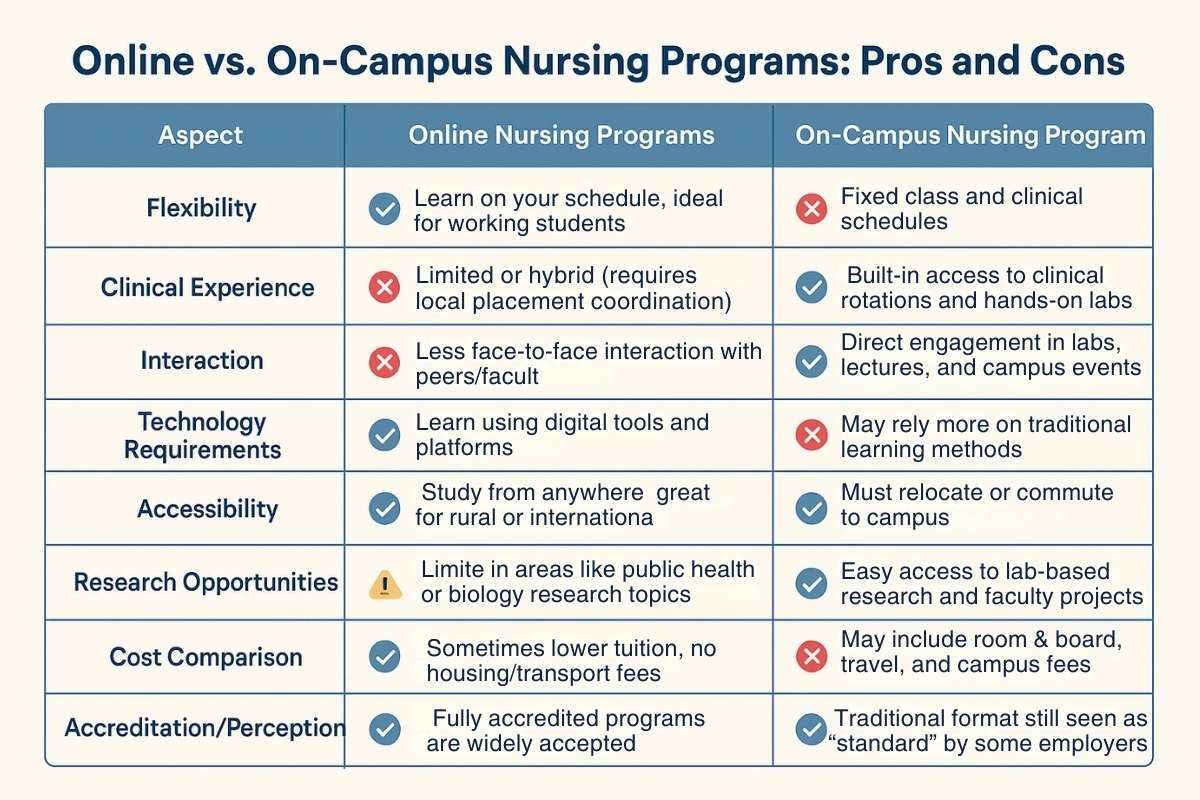
| Aspect | Online Nursing Programs | On-Campus Nursing Programs |
|---|---|---|
| Flexibility | ✔️ Learn on your schedule, ideal for working students | ❌ Fixed class and clinical schedules |
| Clinical Experience | ❌ Limited or hybrid (requires local placement coordination) | ✔️ Built-in access to clinical rotations and hands-on labs |
| Interaction | ❌ Less face-to-face interaction with peers/faculty | ✔️ Direct engagement in labs, lectures, and campus events |
| Technology Requirements | ✔️ Learn using digital tools and platforms | ❌ May rely more on traditional learning methods |
| Accessibility | ✔️ Study from anywhere — great for rural or international | ❌ Must relocate or commute to campus |
| Research Opportunities | ⚠️ Limited, but possible in areas like public health or biology research topics | ✔️ Easier access to lab-based research and faculty projects |
| Cost Comparison | ✔️ Sometimes lower tuition, no housing/transport fees | ❌ May include room & board, travel, and campus fees |
| Accreditation/Perception | ✔️ Fully accredited programs are widely accepted | ✔️ Traditional format still seen as "standard" by some employers |
10. The Best States for Nursing Jobs After College
Making plans for your job after nursing school is a lot like working on one of your more difficult biology projects. You need information, interest, and a long-term objective. One of the best things you can do right now is start thinking about where you want to work. When it comes to employment availability, license requirements, and salary, not all states are the same. These things might have a huge impact on your early career.
California, Texas, and New York are always at the top of the list for nurse pay and demand. For instance, registered nurses in California make an average of more than $120,000 a year. In Florida, on the other hand, the cost of living is lower and jobs are growing steadily. Some states also have shorter licensing processes, better nurse-to-patient ratios, or more flexible alternatives for continuing education. It's not only about the money; it's also about the lifestyle, support, and chances to move up.
Think about where you'll do best in your career and your personal life as you examine your possibilities. Would you rather go to a busy city hospital or a calm country clinic? Are you going to focus on geriatrics, labor and delivery, or global health? The ideal state for your nursing career is the one that helps you flourish in all areas of your life.
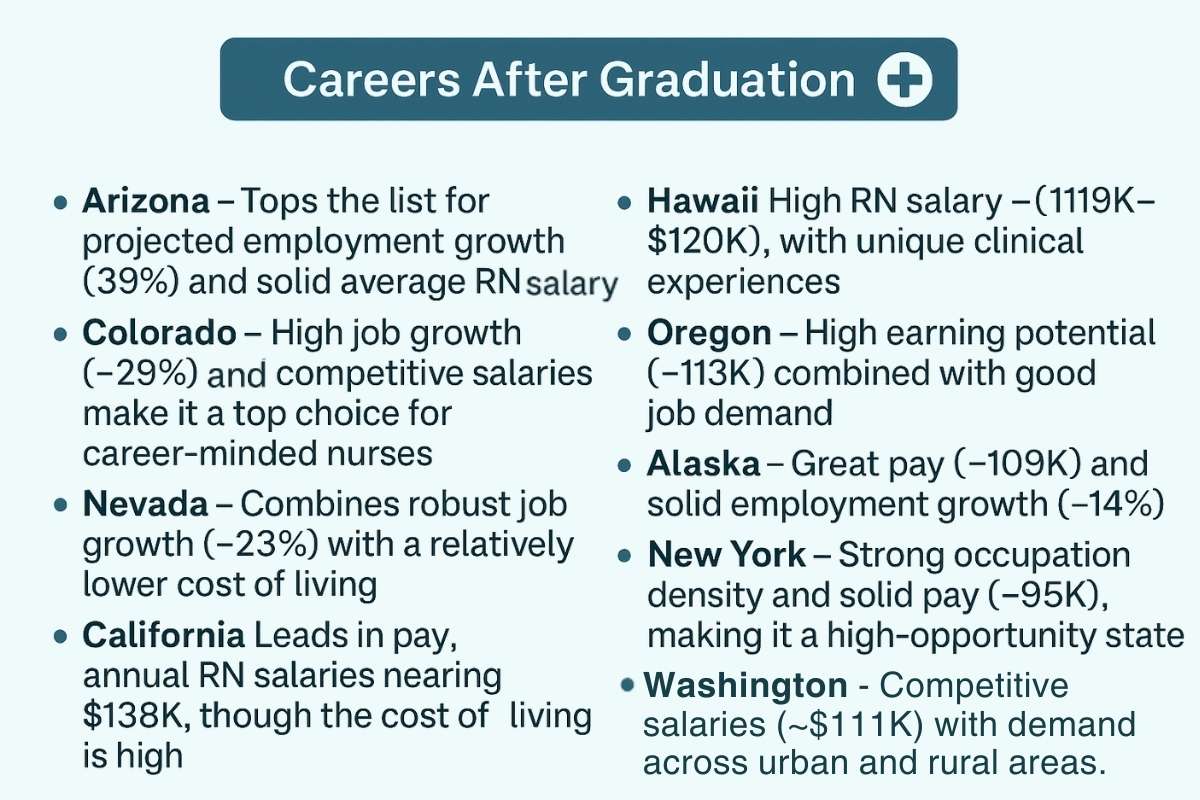
Best States for Nursing Careers After Graduation
- Arizona — Tops the list for projected employment growth (39%) and solid average RN salary.
- Colorado — High job growth (~29%) and competitive salaries make it a top choice for career-minded nurses.
- Nevada — Combines robust job growth (~23%) with a relatively lower cost of living.
- California — Leads in pay, with annual RN salaries nearing $138K, though the cost of living is high.
- Hawaii — Offers one of the highest RN salary averages (~$119–$120K), with unique clinical experiences.
- Oregon — High earning potential (~$113K) combined with good job demand.
- Alaska — Great pay (~$109K) and solid employment growth (~14%).
- Texas — Balanced option with moderate salaries (~$84K), low cost of living, and healthy job growth.
- New York — Strong occupation density and solid pay (~$95K), making it a high-opportunity state.
- Washington — Competitive salaries (~$111K) with demand across urban and rural areas.
| State | Why It's Promising for New Nurses |
|---|---|
| Arizona | Exceptional job growth and solid pay |
| Colorado | Strong growth and competitive salaries |
| Nevada | Good growth + lower living costs |
| California | Highest pay, advanced healthcare infrastructure |
| Hawaii | High salaries and diverse care settings |
| Oregon | High pay with growing healthcare demand |
| Alaska | Great pay with remote healthcare experiences |
| Texas | Affordable living, steady demand, balanced pay |
| New York | High job density and respectable pay |
| Washington | Competitive pay across diverse healthcare markets |
11. Things to Ask When You Visit a Nursing School
A campus visit is more than just a chance to take pictures; it's also a chance to see if a program really suits your aims and interests. Don't be scared to ask direct questions about school. What kinds of biology topics may college students look into? Are there research projects run by students or paid opportunities as lab assistants? You can learn more about how hands-on and research-based the curriculum is by visiting simulation laboratories, following a nursing class, or talking to faculty members directly.
But don't only look at the academics; look into the student experience as well. How many students are there for each faculty member in clinicals? What do students think of their mentors and the amount of work they have to accomplish? Are there counselors who only help with course planning and NCLEX prep? You may also ask about housing, programs that promote diversity and inclusion, or how students deal with stress during difficult rotations. You can go beyond the pamphlet and find a program that helps both the nurse and the person you want to be by visiting in person.
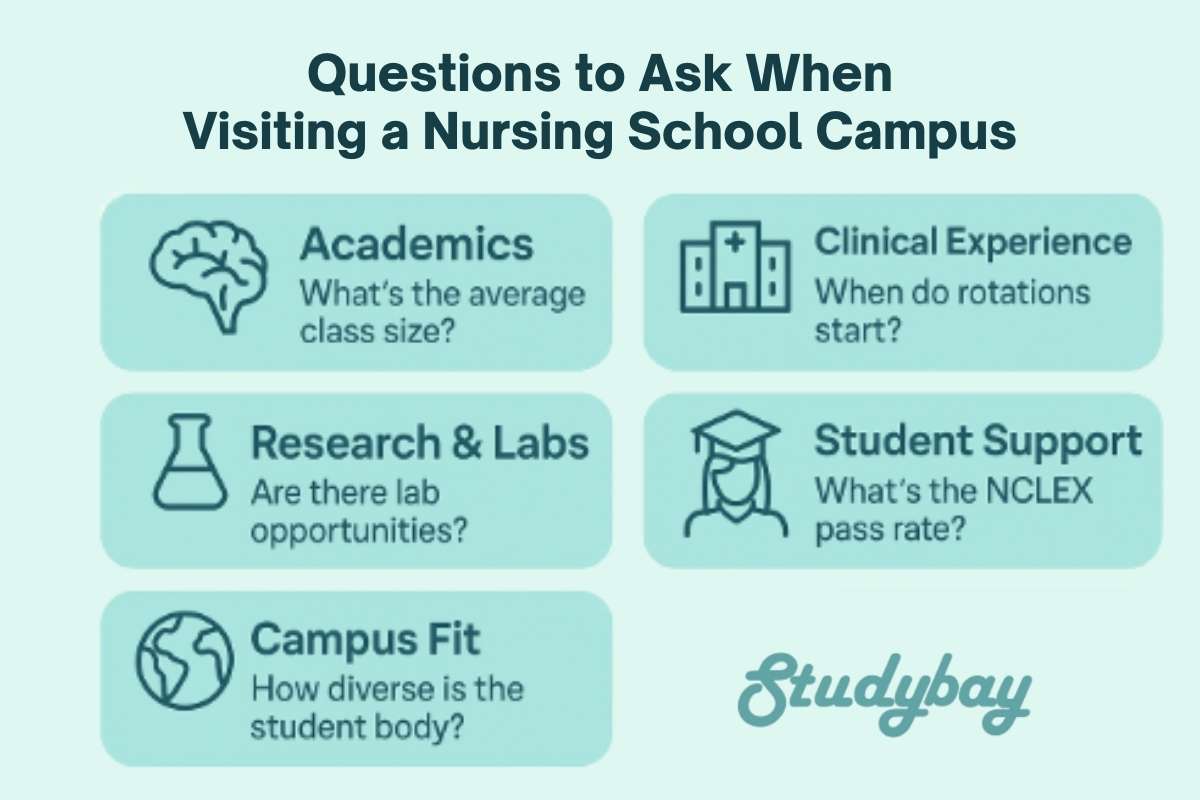
Questions to Ask When Visiting a Nursing School Campus
🧠 Academics & Faculty
- What’s the average class size in nursing-specific courses?
- Are classes taught by full-time nursing faculty or adjunct instructors?
- What academic support is available if I’m struggling in science-heavy courses?
🧪 Research & Labs
- What kinds of biology topics are available for undergraduate nursing students?
- Are there opportunities to work in labs or participate in faculty-led research?
- Is there funding or credit offered for independent research projects?
🏥 Clinical Experience
- When do clinical rotations begin — first year or later?
- Which hospitals or clinics does the school partner with for hands-on training?
- Are simulation labs available on campus? Can I tour one?
👩🎓 Student Support & Career Prep
- What’s the NCLEX pass rate for recent graduates?
- Are there advisors specifically for nursing students?
- What job placement services or career coaching does the school offer?
🌎 Campus Life & Fit
- Are there student organizations specifically for nursing or health sciences?
- How diverse is the student body in the nursing program?
- What’s housing like for nursing students — any health science living communities?
💬 Bonus: Ask a Current Student
- What’s one thing you wish you had known before enrolling?
- How do you manage the workload?
- Would you choose this program again?
13. Questions and Answers
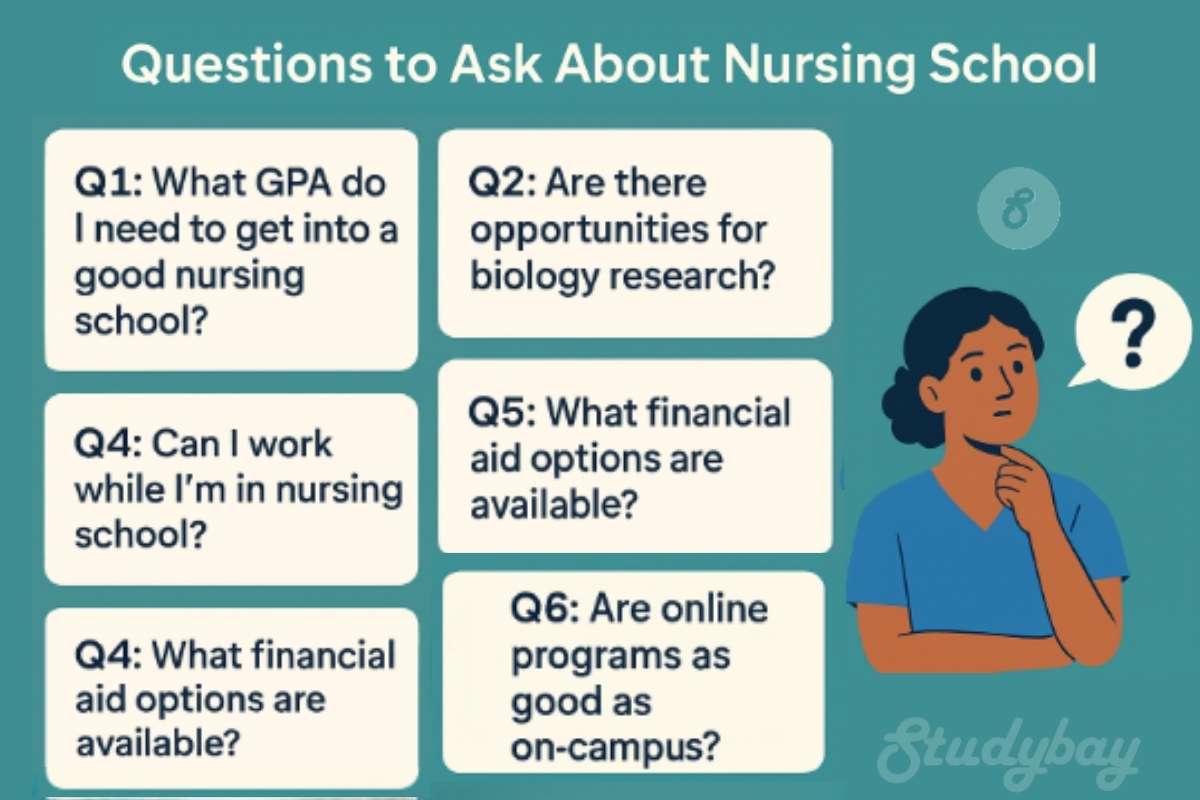
Q1: What GPA do I need to get into a good nursing school?
Most competitive programs want a GPA of 3.5 or better, but many institutions look at your whole application, including your essays, letters of recommendation, and healthcare experience.
Q2: In nursing school, are there chances to look into biology research topics?
Yes, for sure. A lot of nursing schools let students do biology research through labs, honors projects, or interdisciplinary departments. This is especially true in fields like microbiology, anatomy, or health informatics.
Q3: What is a decent NCLEX pass rate?
A passing rate of more than 90% is best. It shows that the institution does a good job of getting students ready for licensure and working in real-world clinics.
Q4: Can I work while I'm in nursing school?
It depends on how hard the software is. There are several part-time or online choices for working students, but full-time BSN programs may need more focus and flexibility.
Q5: What forms of help with money are there for nursing students?
There are various ways to get money, including as federal grants, school-specific scholarships, and nurse corps loan repayment programs. This is especially true if you agree to work in impoverished areas once you graduate.
Q6: Are online nursing schools as good as those that are in person?
Yes, as long as they are accredited. Many of the best colleges now have online or hybrid programs that cover the same material and prepare students for the NCLEX as their on-campus programs.