




47 min
0
08.20.2025

Key Takeaways
- The U.S. hosts many of the world’s leading computer science programs, offering strong research, interdisciplinary opportunities, and pathways to global careers.
- Students should consider more than rankings—factors like location, internships, costs, diversity, and career services play a key role in choosing the right school.
- Top universities such as MIT, Stanford, Carnegie Mellon, and UC Berkeley excel in areas like AI, data science, cybersecurity, and programming.
- Financial aid options, including merit-based scholarships and affordable public programs, make elite computer science education accessible to a wider range of students.
- Internships, co-ops, and alumni networks provide real-world experience and strong career outcomes, with many graduates leading in global tech industries.
- Computer science graduates enter some of the fastest-growing, best-paying careers, from software development to AI research, making the degree highly future-proof.
- Key Takeaways
- Should You Major in Computer Science?
- Is It Hard to Study Computer Science?
- Things to Keep in Mind When Choosing a Computer Science School
- Changes in How People Learn About Computers
- How to Make Sense of Computer Science Rankings
- The Top Computer Science Schools in the US
- The Top Computer Science Schools by Field of Study
- Ivy League Schools for Computer Science
- The Best Computer Science Schools in California
- The Best Computer Science Schools for Your Money
- Computer Science Schools That Offer Merit-Based Aid
- Money and Grants for Students Studying Computer Science
- The Cost and Financial Aid at the Top Computer Science Schools
- Internships and Co-Ops at Top Colleges
- The Best Computer Science Schools for Students
- Numbers on Getting Into the Best CS Colleges
- The 10 Best AI Schools
- The Top 7 Programming Schools
- The 10 Best Schools to Learn About Computers
- Open to Everyone: Computer Science Programs
- Success Stories from Alumni of the Best Computer Science Programs
- Tips for Getting Into Computer Science Programs
- Considering More Than Just a Bachelor's Degree
- The Best Jobs for Computer Science Majors
- More Information About Learning Computer Science
- Frequently Asked Questions
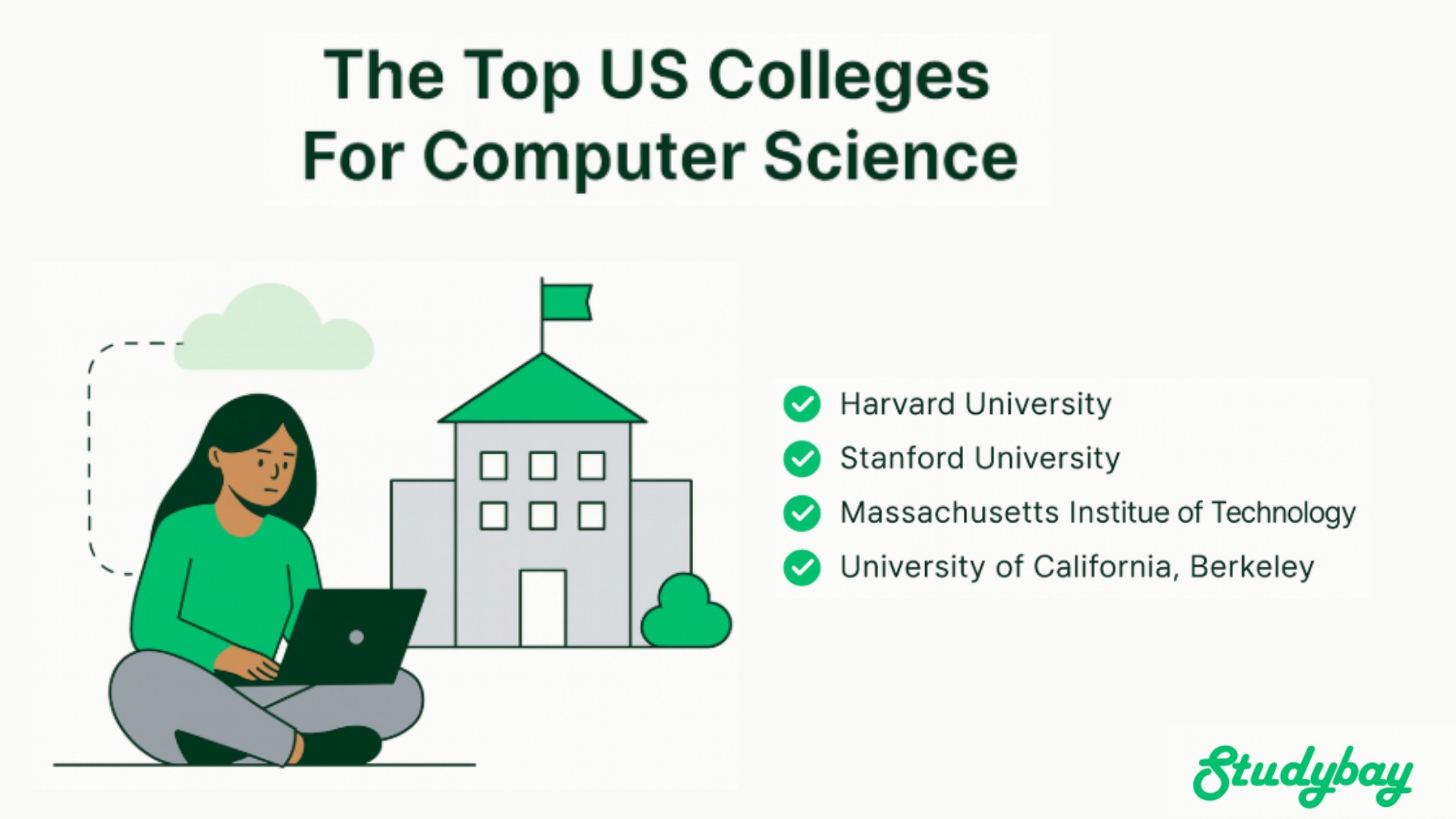
Not merely because of the rankings, the US should be at the top of your list of destinations to study computer science. The U.S. has been a leader in IT education for a long time. Some of the greatest computer science programs in the world are at schools like MIT, Stanford, and Carnegie Mellon.
These colleges stand out not only because of their titles, but also because of the cutting-edge research, hands-on learning, and professors who are experts in AI, data science, and cybersecurity. Schools in the U.S. also promote studying across disciplines, so students can focus their computer science degree on business, health, or the arts. In short, students here don't just learn how to code; they learn how to think of new things.
If you study computer science in the U.S., you can get jobs all over the world. International students with a CS degree can stay in the U.S. for up to three years after they graduate to work in their field because of the STEM OPT extension. This is a great thing for starting a career in computers.
Students can always find internships or jobs with huge companies because many of the best programs are near significant cities like Silicon Valley, Seattle, and Austin. If you love technology and want to turn it into a career around the world, the U.S. is still a smart and strategic decision.
Want to save money on writing your paper?
Try ✨ MyStylus ✨—the best AI service for writing academic papers, created specifically for students!
Try it for FREE!Should You Major in Computer Science?

Yes, especially if you're looking at computer science universities that help students get equipped for the most in-demand occupations right now. Computer science is not just one of the fastest-growing college degrees, but it also pays handsomely.
Recent statistics reveal that the average salary for people who graduated with a degree in computer science is roughly $119,000 a year. Not just software companies need computer science experts; practically every field does. This includes things like health care, money, fun, and school. The finest computer science schools also let you focus on fields that are emerging quickly, such as AI, cybersecurity, and data science. This makes the degree particularly valuable for businesses that are going through changes.
That said, not everyone should learn about computers, and that's okay. To solve difficulties in this subject, you need to use a lot of logic, math, and abstract thinking. Students who do well in computer science programs frequently prefer to break things down, play with code, and think about things in a new way. This major will provide you a strong return on your investment and talents that are useful all over the world if you have these traits. If you're still not sure, though, you should take some basic classes before you fully commit to a CS path.
Is It Hard to Study Computer Science?

Learning computer science can be hard. When students learn new concepts like recursion, data structures, or how to program in C++, they usually have a hard time. It's not unusual to spend hours trying to correct code just to find that you forgot one semicolon.
That said, the academic rigor isn't meant to kick individuals out; it's meant to assist them learn how to solve problems well. A lot of CS students have problems with the parts of the course that are heavy on math, such as linear algebra or discrete math. This is especially true if they haven't worked with technology much previously.
But here's the good news: most students can perform well if they have the right attitude and get guidance. Starting with languages that are easy for beginners, like Python, joining study groups, and practicing outside of class on a regular basis can make a big impact.
It's not vital to know everything on the first day; what's most important is to be curious and powerful. If you like puzzles, logic games, or constructing things from scratch, you will probably find the difficulties of CS both fun and possible. And don't forget that even the best programmers had problems with their first "Hello, World!" when they were just starting out.
Don't have time to read the whole article?
Stop wasting your time, use ✨ MyStylus ✨, and get all the most important information in one click!
Try it for FREE!Things to Keep in Mind When Choosing a Computer Science School

It's a good idea to look at rankings, but they don't tell you everything. You should think about more than just the school's name or reputation when you pick a computer science program. Think about if this school is a suitable fit for your goals, budget, and learning style.
Here's a short list to help you decide:
- Location: Are you close to tech hubs like Austin, Seattle, or the Bay Area? Georgia Tech and Stanford are two colleges that do well because they have significant relationships to industries in the area.
- Internships and links to the industry: Look for programs that have significant ties to internships and co-ops. A lot of the time, these lead to full-time careers.
- Tuition and help: Check out both the total cost and the amount you'll really pay after scholarships, financial aid, or in-state tuition benefits.
- Career Services: Check to see how busy the career center is. Do they let recruiters in, provide resume seminars, or host networking events?
- Student Life and Support: For international students, the diversity on campus, the offices for international students, and housing resources are all very significant. In the U.S., students can put clubs, mentorship programs, or campus culture at the top of their rankings.
The ideal computer science school for you is the one that teaches you well, gets you ready for the real world, and makes you feel at home while you study.
Changes in How People Learn About Computers

It's a good thing that computer science classes aren't the same as they were five years ago. The pandemic sped up a lot of fresh ideas about who can learn CS and how to teach it. People used to think that online CS degrees were second-rate, but today they are really taking off.
The online Master of Science in Computer Science (MSCS) from Georgia Tech is a fantastic example. It offers a hard curriculum and is a lot cheaper than going to school in person. Project-based learning is taking the place of traditional lecture-heavy methods. This implies that students can now build real-world tools, apps, and algorithms while they are in school. These innovations mean that students can now learn in a way that is more useful, flexible, and affordable than ever before.
Another significant thing happening? More and more people are using AI in school and college. Schools like MIT are now offering whole degree programs in things like machine learning, artificial intelligence, and ethical computing. Some colleges even advise their students to look into how AI affects climate science, design, or public policy.
Employers are looking for more and more people who have real-world experience and can work across fields. In response, universities are adding tech innovation to their programs. You will learn more than just how to write if you want to pursue computer science in the future. You will also learn how to be a leader in a world that evolves swiftly and is driven by technology.
How to Make Sense of Computer Science Rankings
Not all university rankings are the same when it comes to computer science. Many individuals believe in the U.S. News, but most of its rankings come from polls of faculty members. This means that a school's academic reputation among its peers is quite essential.
Niche, on the other side, looks at student reviews, graduation rates, and program popularity to present a more student-centered view. Computer Science Degree Hub is another site that rates schools based on how much money they make for their students. It looks at things like how much tuition costs, how much graduates make over time, and how quickly they can find jobs.
One list might put the same school at number one and another one might put it at number five. This is because each list has its own set of criteria. Niche would rank MIT at the top of its list since its programs are popular and work well, while U.S. News might have Stanford at the top because its teachers are so well-known.
If you want to go to a school with a good reputation, one that is cheap, or one that will help you obtain a good job, knowing how the rankings are generated might help you identify the best universities for you. Instead of asking, "What's the best CS school?" you may ask, "Which ranking matches what I care about most?"
The Top Computer Science Schools in the US
If you want to know what colleges have computer science programs that are worth your time, you're in the right place. The United States is home to many of the best computer science universities in the world. They are known for doing cutting-edge research, having great teachers, and helping students get good jobs. These colleges are spread out all over the country, from Silicon Valley to the East Coast, and they all have different ways to get into software development, AI, cybersecurity, and more. Below, we've listed some of the best and most important computer science departments in the country.
- Stanford University (CA) is in the middle of Silicon Valley and has one of the most flexible and innovative computer science programs in the world. Stanford gives students access to the best companies in the world because its faculty members have started significant tech companies and worked with Google and Apple. Some areas of specialization are AI, systems, visuals, and how people and computers interact.
- The Massachusetts Institute of Technology (MIT) is a world leader in machine learning, computing theory, and systems. The CS program at MIT is very research-focused, and undergraduates regularly work on projects that will change the course of technology. The program focuses on arithmetic basics, using math in other fields, and thinking like an entrepreneur.
- Many people think that Carnegie Mellon University (CMU) in Pennsylvania is one of the best CS schools in the U.S. The School of Computer Science has separate majors for AI, robotics, and human-computer interaction. CMU also has one of the best graduate programs for getting jobs in both business and academia.
- At the University of California, Berkeley (CA), you can choose between two tracks: a B.A. and a B.S. Berkeley is known for being strong in theory, systems, and machine learning. It's a great place for students who want to study both core computer science and new subjects because it's close to big tech companies and has a lot of research going on on campus.
- Harvard University in Massachusetts combines liberal arts with computer science to give students a well-rounded experience with a lot of technical depth. The curriculum focuses on applied computer science, ethics in AI, and learning across disciplines. It's a great place for students who want to be respected and work with people from other campuses.
- The University of Illinois Urbana-Champaign (UIUC) is known for its research and its large, well-funded computer science department. UIUC is a popular choice for both domestic and international students because it has strong ties to big tech companies and low in-state tuition. Its alumni network includes people who work for Fortune 500 companies and startups in Silicon Valley.
- Cornell University, Georgia Tech, and the University of Washington also have some of the best computer science departments. These top schools have the resources, faculty expertise, and professional tools to help you start your tech career, whether you want to work in software systems, data science, or computational biology.
Need to write an essay?
Use the ✨ MyStylus ✨ essay generator and get your A+ academic paper in just 5 minutes!
Try it for FREE!The Top Computer Science Schools by Field of Study
Don't just look at the overall rankings when you're looking for computer science schools. Find out what each program does best. Many of the best colleges offer CS degrees, but they usually have strengths in certain areas. Choosing a school that fits your interests in AI, game development, or cybersecurity could have a big effect on your education and job prospects in the future.
- Carnegie Mellon University is the finest location to go if you want to work in AI and machine learning. It has particular undergraduate degrees in AI and robotics. MIT and Stanford also offer cutting-edge AI classes, some of which even touch on ethics and neurology.
- Georgia Tech and the University of Maryland–College Park are both wonderful places to do research, make connections in the industry, and get hands-on experience in cybersecurity.
- If you want to study data science, you should check out programs at UC Berkeley or UIUC. There, you can study computer science, statistics, and computational modeling all at the same time.
- You can also specialize in innovative and cross-disciplinary subjects. For example, Rochester is known for its flexible computer science degrees that let students study music, business, or biology along with computers.
- Rensselaer Polytechnic Institute (RPI) is noted for its work in game design, simulation, and immersive media.
- Colleges like Cornell and the University of Washington provide fantastic teaching and research possibilities for graphics and HCI. If you want to work in a given area of computer science, start with what you like and then choose the school that is best for that subject.
Ivy League Schools for Computer Science

The Ivy League is recognized for being prestigious, but not all of the Ivies have the same computer science departments. These top-notch colleges offer amazing access to academics, world-class research, and strong alumni networks, but their computer science programs aren't always the best.
If you're interested in the Ivies because of their name, you should also think about how well you fit in academically, the research opportunities, and the way they teach. Many Ivy CS schools focus more on theory and basic knowledge than on vocational training. This is great for some students, but not all of them.
- Cornell University is different from the other Ivies since it has a dual-track CS degree that students can acquire through the College of Engineering and the College of Arts and Sciences. Students also gain early access to internships and research.
- Princeton University is known for its independent research model, which encourages undergraduates to work on novel ideas in subjects like AI and systems design. This is great for people who want to proceed to grad school.
- Students at Harvard University can study computer science along with economics, neurology, or ethics. They also have a lot of resources and faculty supervision. All Ivy League CS programs are very academically challenging, but students should look beyond reputation to find the one that best fits their interests and learning style.
The Best Computer Science Schools in California
California is one of the best places in the world to study computer science. It has everything from businesses in Silicon Valley to innovation hubs on the West Coast. It's not surprising that a lot of CS students move to California. The state has great public and private universities, a lot of internships, and easy access to big tech companies.
If you want to work in IT, California's computer science programs are a terrific place to start. You can study cutting-edge AI research, transdisciplinary programs, or even create your own firm.
- Stanford University is in Silicon Valley and is known for being inventive. The institution has a startup culture and strong ties to the business world, making it a fantastic destination for both ambitious founders and programmers.
- UC Berkeley is one of the greatest computer science departments in the US. It is highly good at systems, machine learning, and cybersecurity.
- Caltech is a tough, research-based computer science program that is perfect for anyone who are interested in both theoretical and practical science.
- UC San Diego (UCSD) is known for several things, including bioinformatics, machine learning, and computational biology.
- UCLA provides a well-rounded computer science department that is intimately related to technology in the media and entertainment industries. No matter what your computer science interests are, California has a program and a tech ecosystem that will fit them.
The Best Computer Science Schools for Your Money
When it comes to computer science schools, bigger isn't always better, and more costly isn't always smarter. Ivy League and private institutions get a lot of press, but many public colleges provide superb computer science degrees that are considerably better value for money.
These colleges are often well-known for their academics, job prospects, and low tuition costs, especially for students from the same state or those who can get financial aid. If you choose a best-value CS program, you can get the skills that companies want without going into a lot of debt.
- Georgia Tech, for instance, has a nationally renowned CS department with strong ties to the business world and a long history of placing tech students, all for the cost of a public institution.
- The University of Illinois Urbana-Champaign (UIUC) is a great place to do research and be ready for a profession. They also give a lot of financial aid depending on need and merit.
- The University of Florida (UF) offers the lowest cost of attendance for in-state students among top CS schools, and it nevertheless does well in AI, software engineering, and data science.
You don't have to go to an Ivy League institution to learn about computers at a world-class level. All you need is the right mix of chance and cost.
Computer Science Schools That Offer Merit-Based Aid
Are you worried that private universities are too expensive for you? You're not the only one. But merit-based scholarships can make even the best computer science programs surprisingly cheap. Need-based aid is based on how much money someone needs, while merit grants are based on academic success, leadership, or particular skills.
If your family doesn't qualify for need-based support but still has difficulties paying for school due of rising prices, these scholarships can be very helpful. Merit-based help can help strong students get into top schools without having to pay for everything.
- When it comes to merit aid, Rensselaer Polytechnic Institute (RPI) is one of the best CS schools. It gives out about $36,000 a year on average.
- There are a lot of scholarships available at Northwestern University, and they are worth an average of over $32,000. But the competition is intense.
- Brown University is one of the few Ivy League schools that gives out merit-based awards. The average award is $19,000.
- Also, a lot of students who get into the University of Southern California (USC) obtain more than $18,000 in scholarships through programs like the Trustee and Presidential honors.
If you want to attend to a good school but are worried about the money, think about merit aid. It could be what you need to get into the school you want.
Money and Grants for Students Studying Computer Science
Getting a degree in computer science doesn't have to cost a lot of money. College students can apply for scholarships, grants, and tuition assistance programs. You can get money from your college, the government, businesses, or charitable organizations.
Many computer science departments provide merit-based scholarships, and students who need money may also be eligible to acquire government grants like Pell or FSEOG. Some universities even let undergrads serve as research or teaching assistants on faculty-led projects.
Outside of school, private tech companies and NGOs contribute a lot of money to assist future technicians succeed. For example, the S-STEM program gives money to low-income students who wish to obtain STEM degrees at partner universities.
Tech corporations like Google also offer out scholarships. The Google Student Veterans of America Scholarship, for example, gives $10,000 to military-connected students studying computer science who meet certain requirements.
There are more scholarships for women in tech, first-generation students, and minorities who aren't well represented. If you do some research and apply early, you might be able to earn a lot more money for your computer science degree than you expect.
The Cost and Financial Aid at the Top Computer Science Schools
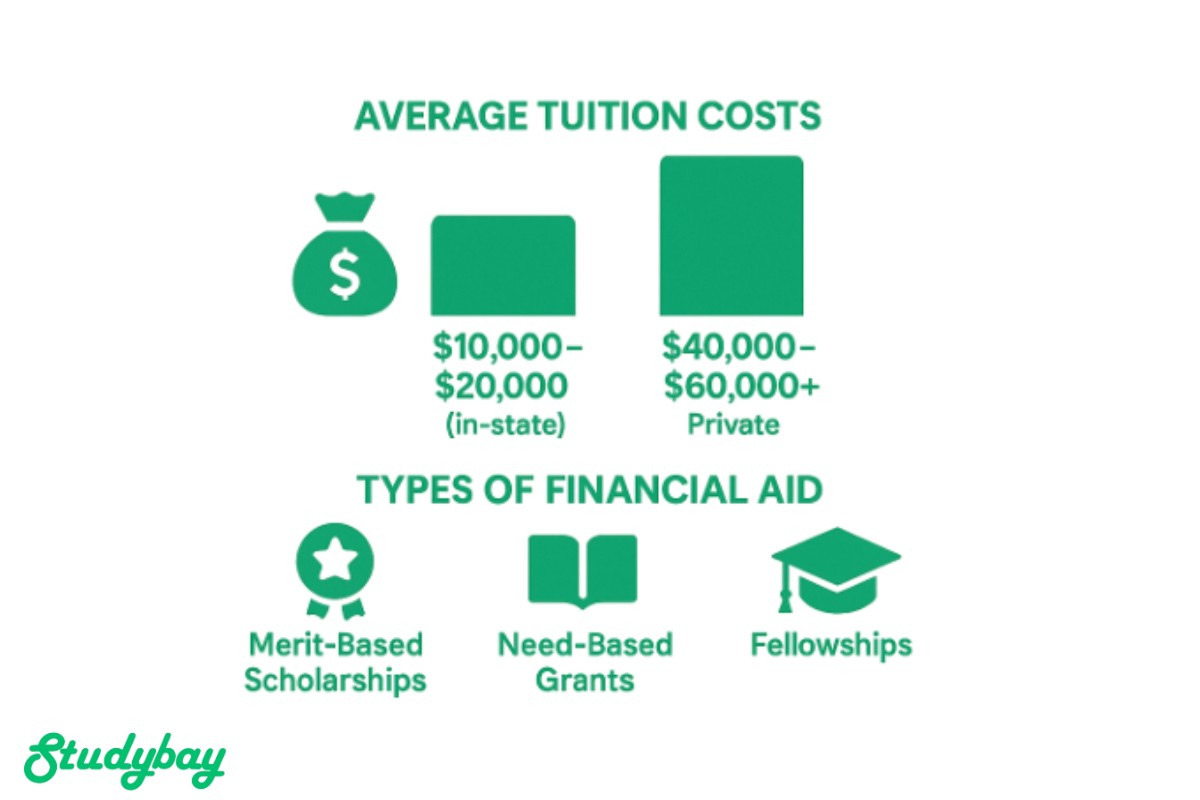
The cost of a computer science degree can vary greatly depending on where you live and go to school. In general, public colleges charge less for students who live in the state, whereas private schools charge more for everyone.
For example, the University of Florida's average cost for in-state students is $23,500, which makes it one of the most affordable top computer science programs in the US. On the other hand, private schools like MIT say that the full cost is closer to $80,000 a year. Kids from other states who go to public schools should also expect to spend a lot more than kids from their own state.
That being said, the price on the sticker doesn't always tell the entire picture. Many top private schools give out a lot of need-based aid, which can cut the true cost a lot, sometimes even lower than a public university.
Grants, scholarships, and work-study can all be part of an aid package. This means that students don't have to take out as many loans. When you compare computer science programs, make sure to use net pricing calculators and talk to the financial aid offices. Anything's not just about how much something costs; it's also about how much value you get for your money.
Internships and Co-Ops at Top Colleges
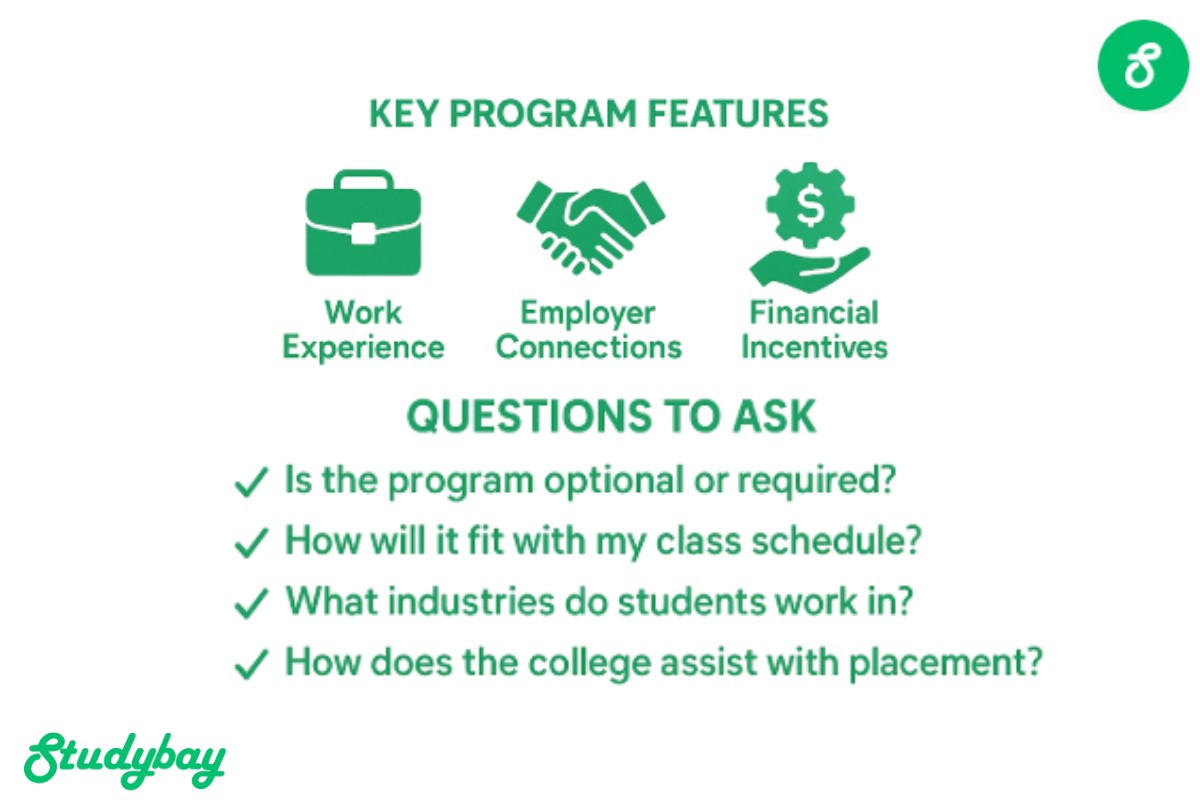
Internships and co-op programs help students connect what they learn in school with what tech companies want. They give students the real-world experience that top tech companies want.
A co-op, which stands for "cooperative education," is usually a full-time, paid job that lasts a semester or more and is part of a student's school schedule. Co-ops are different from summer internships in that they usually let you work on more projects and can sometimes be used for credit.
People think that some of the greatest computer science programs assist students find jobs. Northeastern University has one of the best co-op programs in the country, working with thousands of companies all over the world.
A lot of Georgia Tech students have connections to the business sector; 60% of them do internships or co-ops before they graduate.
The Computer Forum at Stanford helps students network and get jobs faster by connecting them with companies like Apple, NVIDIA, and Google. These colleges offer more than just a degree; they also give you a direct path into the tech field right after you graduate.
The Best Computer Science Schools for Students
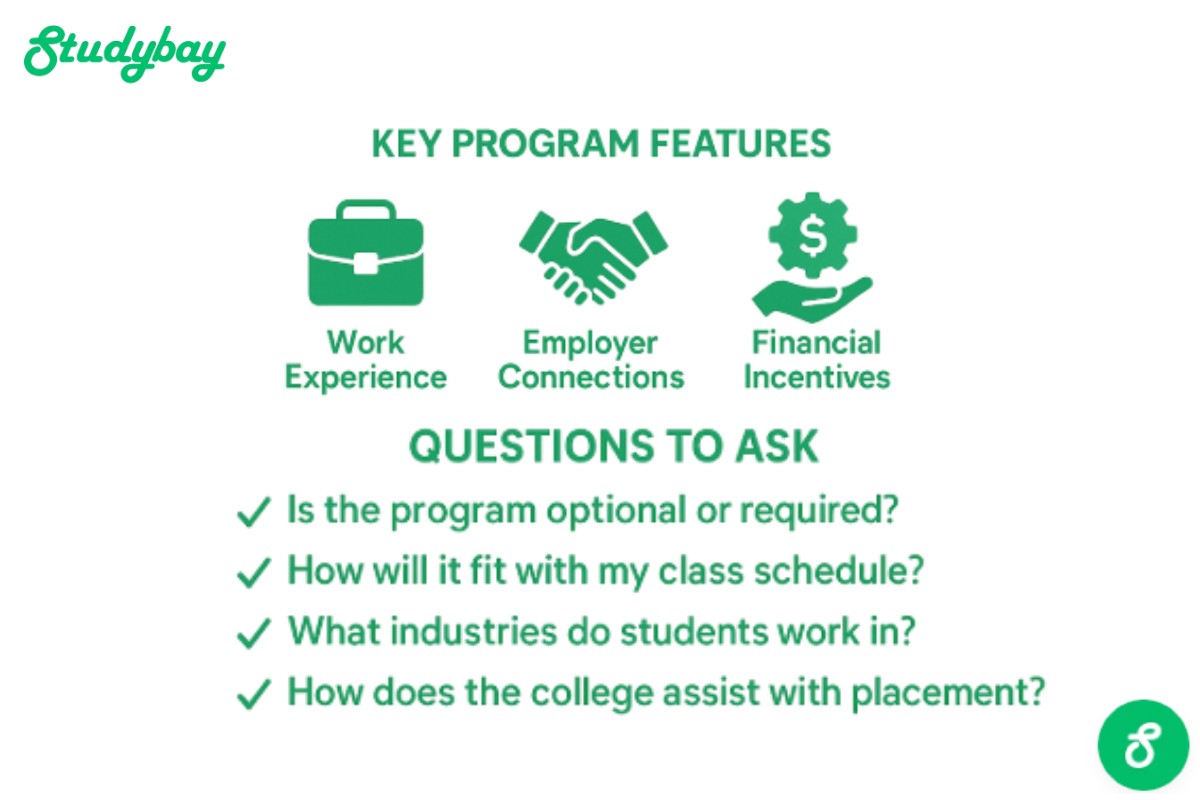
You should look at more than simply rankings when choosing an academically demanding program. The best schools have faculty research, a broad curriculum, and high student outcomes.
The best computer science departments don't just teach the newest technology; they also come up with new ideas. This means that students usually have access to funded research labs, chances to write papers with other people, and the chance to learn from the people who are at the forefront of AI, systems, and theoretical computing.
Three colleges stand out in this case. Carnegie Mellon University (CMU) is known around the world for its work in AI and robotics. Faculty members regularly publish in top journals and get millions of dollars in funding. MIT mixes research and engineering across fields, so computer science students can work in labs on a wide range of topics, from quantum computing to ethical AI.
Undergrads at the University of Illinois Urbana-Champaign (UIUC) can become involved in applied research right away through its NSF-funded labs and cybersecurity programs. If you care most about academics and research, these colleges are always at the cutting edge.
Numbers on Getting Into the Best CS Colleges
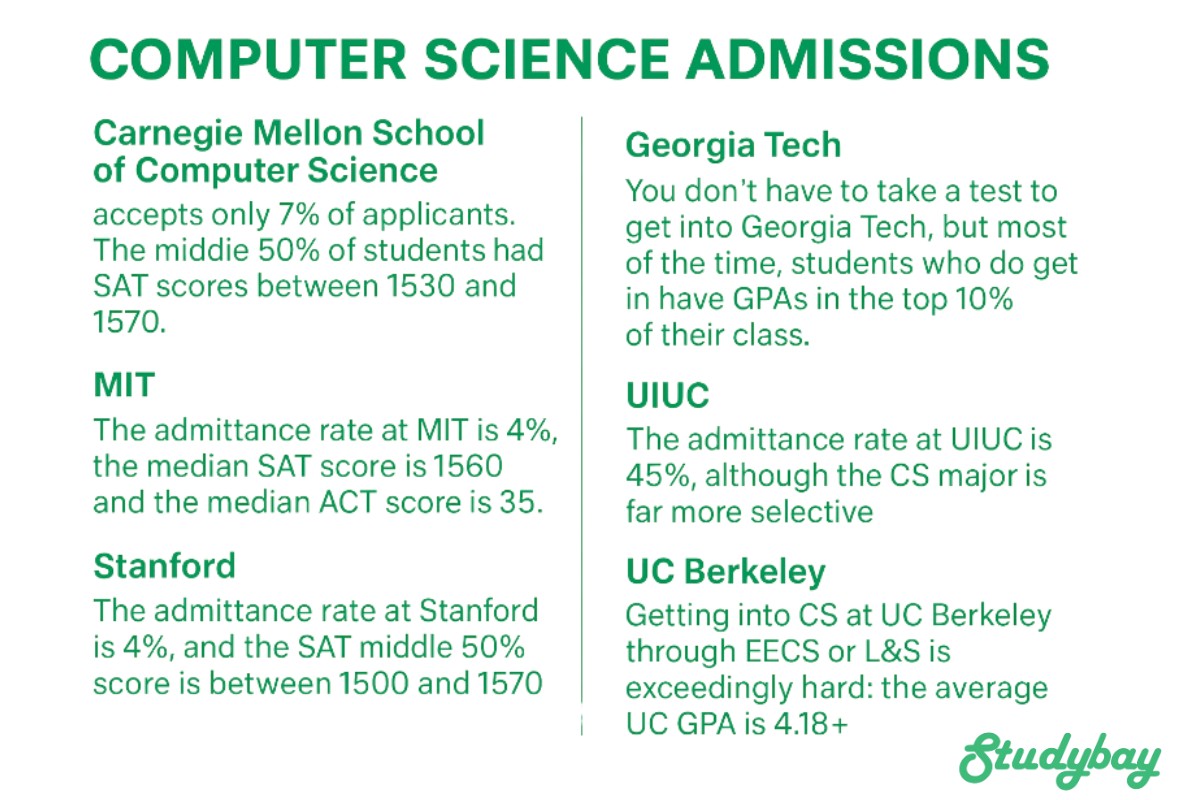
It's not easy to get into a top computer science program. These schools are very picky and get thousands of good applications every year. But most of the time, getting in isn't just about the numbers. Most of the time, successful applicants have high GPAs, tough classes, and interesting essays.
Coding competitions, research, and internships are some fantastic methods to prove that you can solve issues, are skilled at math, and want to learn more.
Here's a quick glimpse at how admissions work:
- The Carnegie Mellon School of Computer Science accepts only 7% of applicants. The middle 50% of students had SAT scores between 1530 and 1570.
- The admittance rate at MIT is 4%, the median SAT score is 1560, and the median ACT score is 35.
- The admittance rate at Stanford is 4%, and the SAT middle 50% score is between 1500 and 1570.
- You don't have to take a test to get into Georgia Tech, but most of the time, students who do get in have GPAs in the top 10% of their class.
- The admittance rate at UIUC is 45%, although the CS major is far more selective.
- Getting into CS at UC Berkeley through EECS or L&S is exceedingly hard; the average UC GPA is 4.18+.
These stats can worry you, but they could also help you. The most important thing is to apply to a solid mix of reach, match, and safety schools and craft a fantastic, well-rounded application.
The 10 Best AI Schools
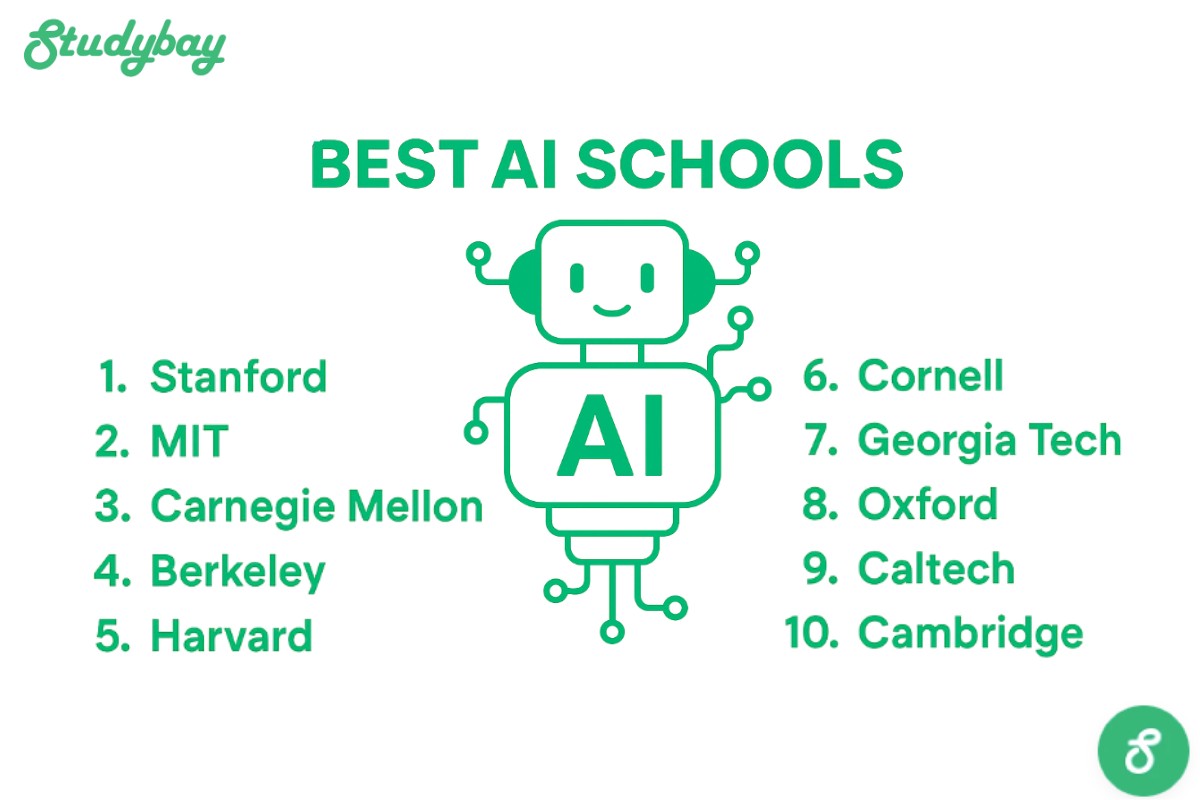
To find the finest computer science schools for artificial intelligence, look for ones that combine basic computer science with cutting-edge AI research.
The best schools for AI don't just have electives; they also have labs just for AI, hire top-notch professors, and often let undergraduates do research with grad students. These programs prepare students to be leaders in one of the fastest-growing IT fields as AI changes fields like robotics and healthcare.
Here are eleven colleges where AI isn't just a buzzword; it's a big part of research and academics:
- The prestigious School of Computer Science and specialized AI degrees are at Carnegie Mellon University. The school is also a leader in robotics, machine learning, and cognitive systems.
- A lot of MIT's AI research happens at the Computer Science and Artificial Intelligence Laboratory (CSAIL). This includes work on deep learning, computer vision, and ethics.
- Stanford University offers a great AI program with academics who were among the first to make key discoveries in neural networks and natural language processing. The school is also quite close to AI labs in Silicon Valley.
- The Berkeley Artificial Intelligence Research (BAIR) Lab at UC Berkeley has more than 30 professors who focus on ML, robotics, and theory.
- The University of Washington's AI@UW is one of the greatest venues in the world for language processing, computer vision, and machine learning.
- People all across the world know about the University of Toronto's work on AI, like Geoffrey Hinton's group's study on deep learning.
- University of Texas at Austin: Good teachers in AI planning, knowledge representation, and multi-agent systems.
- Georgia Tech is known for using AI in real life in things like robotics, healthcare, and cars that drive themselves.
- The Cornell AI Initiative at Cornell University brings together machine learning with philosophy, law, and ethics.
- There are a number of classes and research at the University of Michigan on AI, especially on reinforcement learning and perception systems.
These institutions will give you the academic depth and industry connections you need to launch a career that will make a difference, whether you want to work on AI ethics research or develop the next generative model.
The Top 7 Programming Schools
The best computer science schools don't just teach theory; they get students to work with code right away. The best computer science departments that focus on programming put a lot of emphasis on hands-on learning. Their courses start with languages like Python or Java and then move on to systems programming, software architecture, and real-world development environments.
These colleges provide a great education and access to open-source projects, hackathons, and research labs that simulate the kinds of problems that modern software engineers deal with. For students who want to become professional developers, the program's structure and hands-on experience are just as important as the school's reputation.
Here are some of the finest ways to become a great programmer:
- One of the hardest coding programs in the U.S. is at Carnegie Mellon University (CMU). It concentrates on C, functional programming, and software systems.
- Stanford University is noted for teaching Python, Java, and C++. It also encourages students to seek internships and work on open-source projects.
- University of Illinois Urbana-Champaign (UIUC): Classes on distributed systems and compiler design that focus on how to make things bigger and how to think about the whole system.
- Princeton University: Has a strong theoretical background and gives students early experience to Java, addressing algorithmic challenges, and making things run faster.
- Cornell University: Students learn how to make mobile apps, interact with databases, and use web frameworks to prepare for careers in software.
- Harvard University's CS50, its introductory course, is famous for turning beginners become expert coders through weekly coding challenges.
- The University of Washington has great programs for learning programming languages and designing software that is easy to use.
These classes provide students the confidence and fluency they need to write code that is clean, fast, and easy to scale. These are skills that are always in demand in the computer industry.
The 10 Best Schools to Learn About Computers
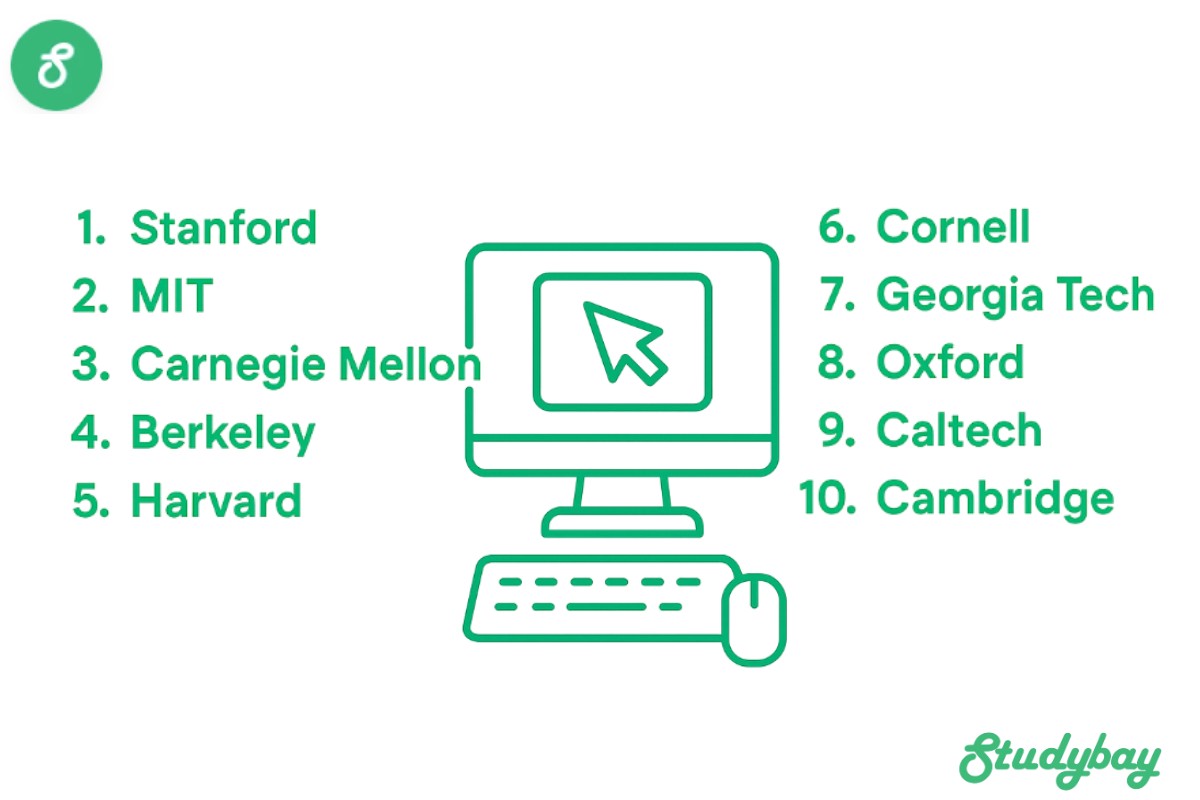
The best computer science schools don't just teach students how to code; they also educate them how computers work at their most basic level. Important topics in theoretical computer science include algorithms, computational complexity, automata theory, and logic.
Students who know a lot about theory can produce better software, make it run faster, and help AI, cryptography, and systems make progress over time. This is also the most important thing for students who want to work in computer science in an academic or research setting to know.
Some of the greatest programs in this field are:
- MIT is famous for its innovative work in algorithms and complexity theory. It is also home to some of the best TCS professionals in the world.
- The theory group at UC Berkeley does a lot of work on quantum computing, cryptography, and computational complexity.
- The computer science program at Princeton University is one of the most rigorous in the country, and its faculty is pursuing research in proof systems and logic.
- Cornell University is excellent in both fundamental theory and connections between various subjects, like computational biology and distributed systems.
- Carnegie Mellon University: The School of Computer Science puts a lot of emphasis on formal methods and automata, which are key portions of theoretical CS.
- University of Washington: Has a lot of knowledge in algorithms, graph theory, and formal verification.
- Georgia Tech is getting increased attention for its research in online computation, algorithms, and approximation theory.
These institutions are fantastic for kids who want to understand not just how computers work, but also why they work the way they do.
Open to Everyone: Computer Science Programs
Computer science is getting bigger, but not everyone has the same access to it. More women, students of color, LGBTQ+ students, and international applicants are joining CS schools than ever before, yet there are still gaps in support and representation.
When it comes to inclusive education, it's not just about the numbers. It's also about making sure that students from all backgrounds can succeed, make a difference, and see themselves in faculty and leadership.
The good news is that a lot of the best computer science departments are really working to fix those problems. The Grace Hopper Celebration and the National Center for Women & Information Technology (NCWIT) are two programs that help women in tech by giving them mentors, scholarships, and chances to meet other women in the field.
Schools like Stanford, MIT, and Georgia Tech have diversity centers, LGBTQ+ student support networks, and grants for students from groups that aren't well represented. Some schools also have coding groups that meet in the community, internships that focus on diversity, equity, and inclusion, and money for students from other countries.
These efforts show that the academic pipeline is trying to become more accessible, but it still has a long way to go.
Success Stories from Alumni of the Best Computer Science Programs
One of the greatest ways to find out how useful a computer science degree is is to look at what graduates do with it. At the finest schools, alumni networks are more than just impressive; they transform lives.
These institutions don't only generate outstanding engineers; they also make business owners, inventors, and tech leaders who revolutionize whole industries. Students usually have a head start on their careers because they have access to great professors, research opportunities, and early exposure to fast-growing companies.
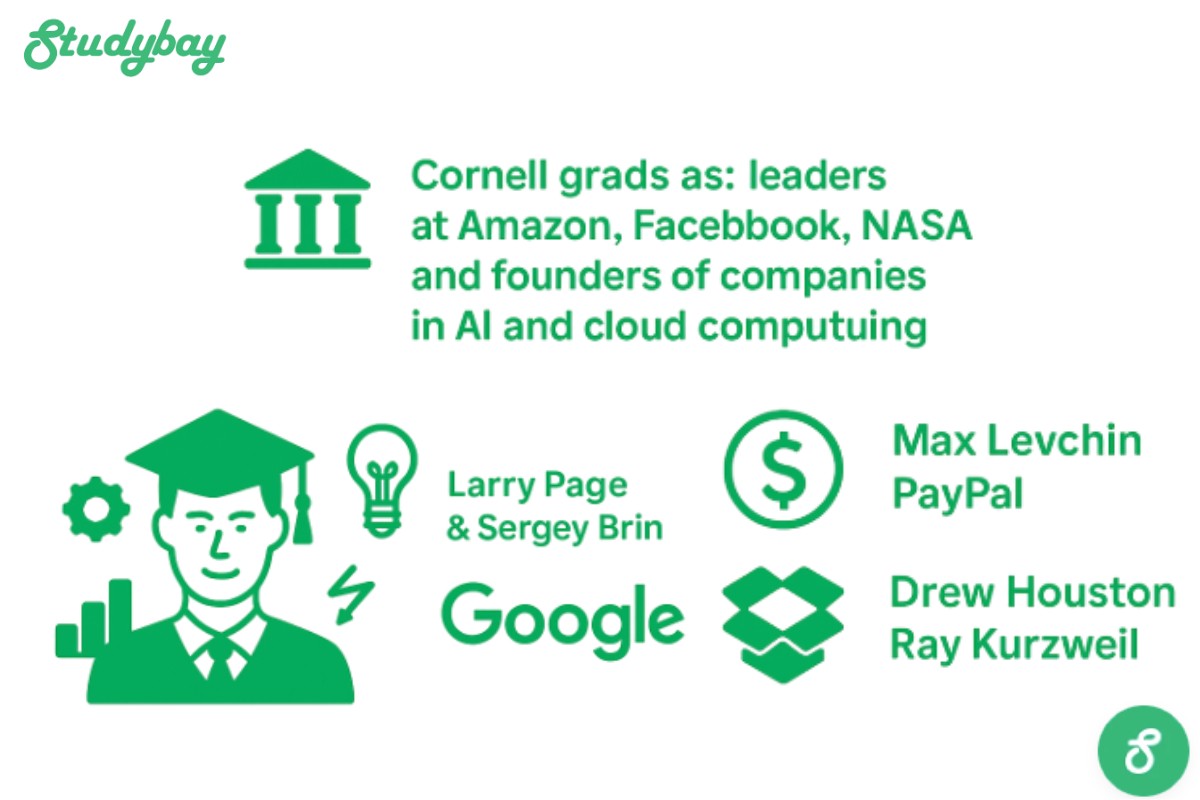
For instance, Larry Page and Sergey Brin, who started Google together after meeting at Stanford while studying computer science, both went to the same school.
Both Drew Houston, who co-founded Dropbox, and Ray Kurzweil, a well-known inventor and Google's Director of Engineering, went to MIT.
Max Levchin, who helped develop PayPal, and Marc Andreessen, who helped make the first popular web browser, also went to UIUC.
Some Cornell grads have gone on to lead teams at Amazon, Facebook, and NASA. Others have even launched their own successful AI and cloud computing businesses.
These success stories highlight what can happen when talent is put in the right place. They also show why it's crucial to have strong alumni networks when choosing a CS school.
Tips for Getting Into Computer Science Programs
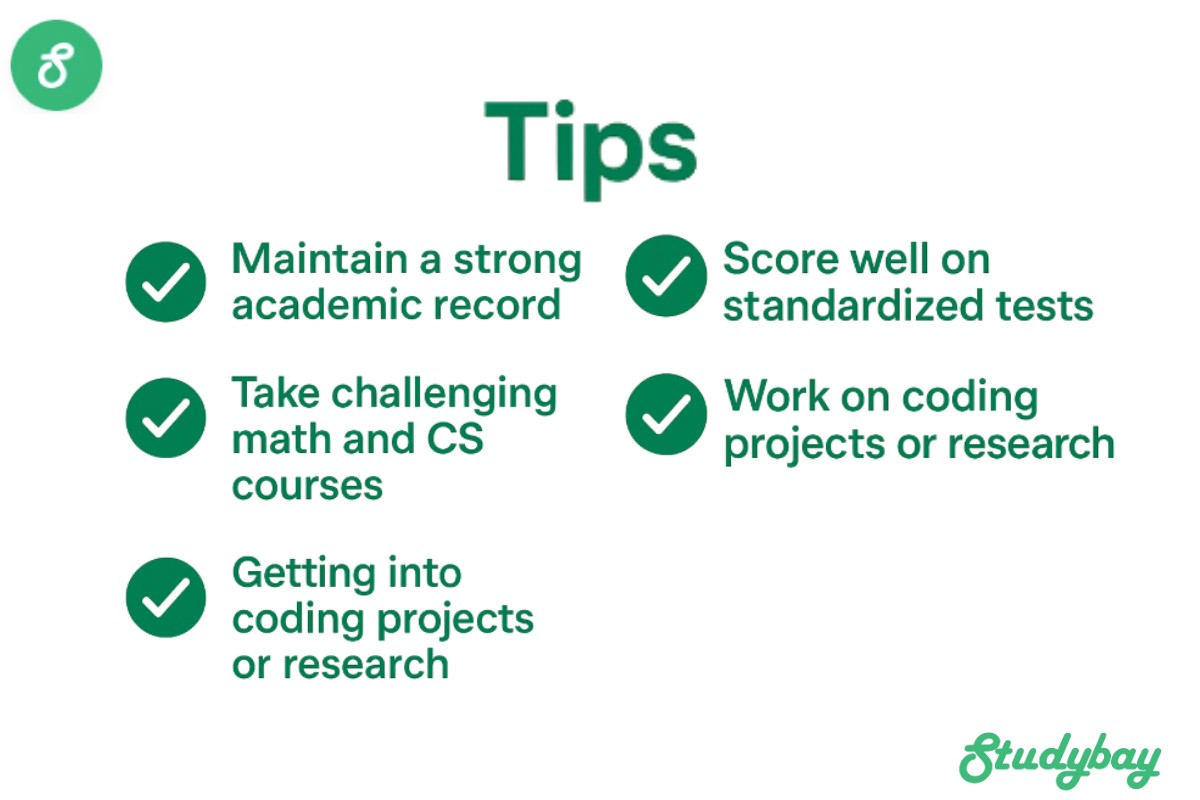
To get into a competitive computer science school, you need more than just strong grades and test scores. Admissions committees want to see proof that you can solve problems, are interested in computers, and love learning.
One of the best ways to stand out is to write a personal statement that goes beyond clichés like "I've always loved computers" and explains how specific experiences, like designing an app, teaching math to classmates, or playing with code, made you more passionate about computers. Top schools also look for students who are good at math (especially calculus) and have some coding experience, even if they learned it on their own.
To make your application stand out, show off your skills. You may do this by sending in a GitHub portfolio or personal website that shows off your class work, open-source contributions, or anything else you've developed on your own.
If your school doesn't have computer science classes, talk about what you've done on your own, like taking online classes, entering contests, or getting help from a mentor. When you ask for recommendation letters, choose teachers or mentors who can talk about your analytical thinking or work ethic in technical settings. But don't wait until the last minute. Many of the best applications come from planning, revising, and thinking about them ahead of time.
Considering More Than Just a Bachelor's Degree
There are many jobs that you can get with a bachelor's degree in computer science. But if you want to focus on a certain area, change your concentration, or do research, graduate school might be the best next step. Master's degrees like the MSCS (Master of Science in Computer Science) give you a lot of technical knowledge and are great for people who want to work in AI, machine learning, or advanced systems engineering.
Some people might prefer to acquire a Master of Engineering (MEng) instead, which is more focused on projects and the industry. A PhD in Computer Science is what many students who want to teach or undertake cutting-edge research get. This can lead to work in academia or research and development labs.
There are many different kinds of programs, and they are all easy to access to. The Georgia Tech Online MSCS (OMSCS) is currently one of the most respected and affordable online degrees. It lets students work while they receive their degree.
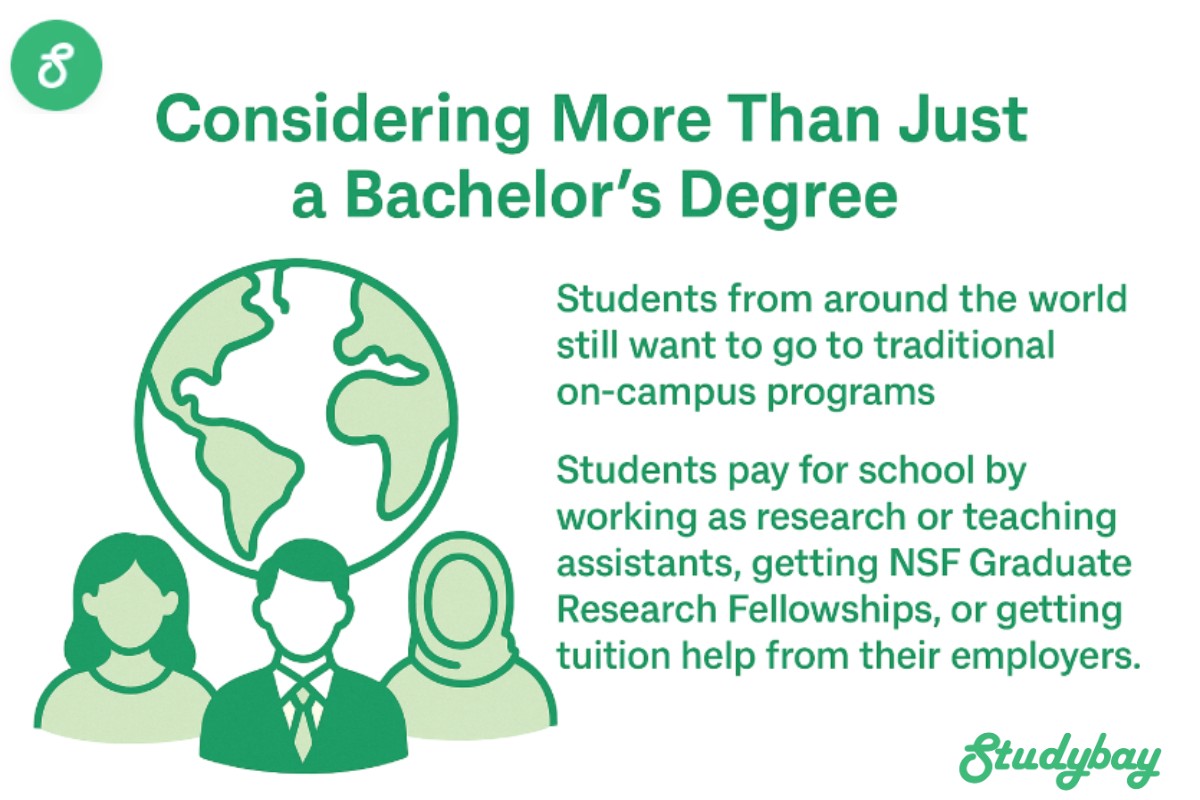
Many of the best students from around the world still want to go to traditional on-campus programs like Stanford's MSCS. A lot of students pay for school by working as research or teaching assistants, getting NSF Graduate Research Fellowships, or getting tuition help from their employers. For students who are motivated, grad school can be a great next step in a long and successful career in computer science.
The Best Jobs for Computer Science Majors
Getting a degree in computer science is more than just getting a job; it's the first step toward some of the fastest-growing, highest-paying jobs in the world. CS students have a variety of options in numerous disciplines, whether they want to build apps, guard networks, or look at data.
The Bureau of Labor Statistics says that jobs in computer and information technology will grow by 15% from 2021 to 2031, which is much faster than the average for all industries. Because of this growth, as well as high demand and good starting salaries, computer science is one of the most future-proof degrees you can get.
If you have a degree in computer science, these are some of the top professions you can get:
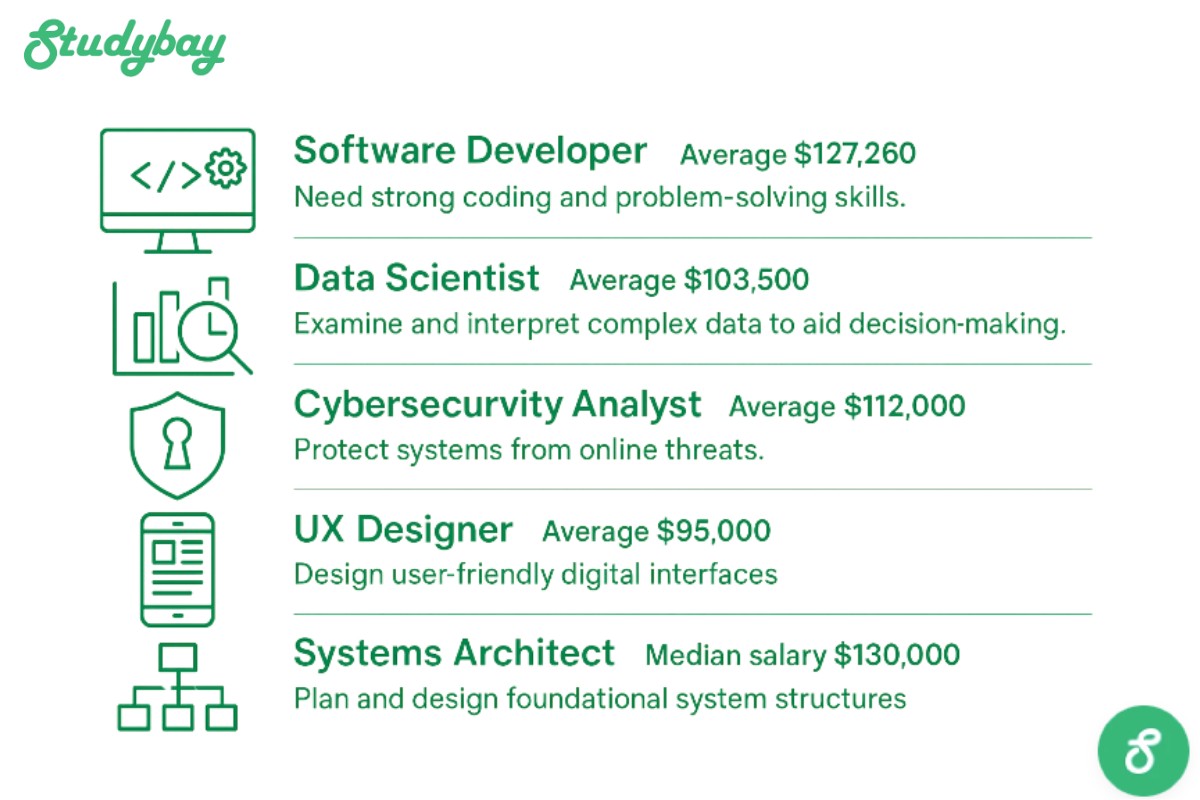
- Software Developer: The average salary is $127,260. They need to be able to code well and solve problems.
- Data Scientists: Look at and comprehend complicated data to help people make decisions. They make an average of $103,500 a year and are good at Python, R, and statistical methods.
- Cybersecurity Analysts: Protect systems from online attacks. They make an average of $112,000 a year and need to know about network security and risk management.
- UX Designer: Create digital interfaces that are simple to navigate. Average salary: $95,000. Combines coding with design thinking and user research.
- Systems Architect: Plan and design the basic structures of systems. Median salary: around $130,000. This job requires a lot of technical knowledge and experience in systems design.
All of these positions let you work on real problems and establish a career that you will like over time.
More Information About Learning Computer Science
There are a lot of great resources out there to help you learn if you're thinking about going to college for computer science or want to get a head start before you apply. The best applicants often do extra study on their own, whether that means going over the basics of programming, learning new ways to solve problems, or looking at the bigger picture of computer science. These materials not only help you learn new skills, but they can also make your college applications stronger by showing that you are interested and taking the initiative.
These are some things that people who want to major in computer science should use:
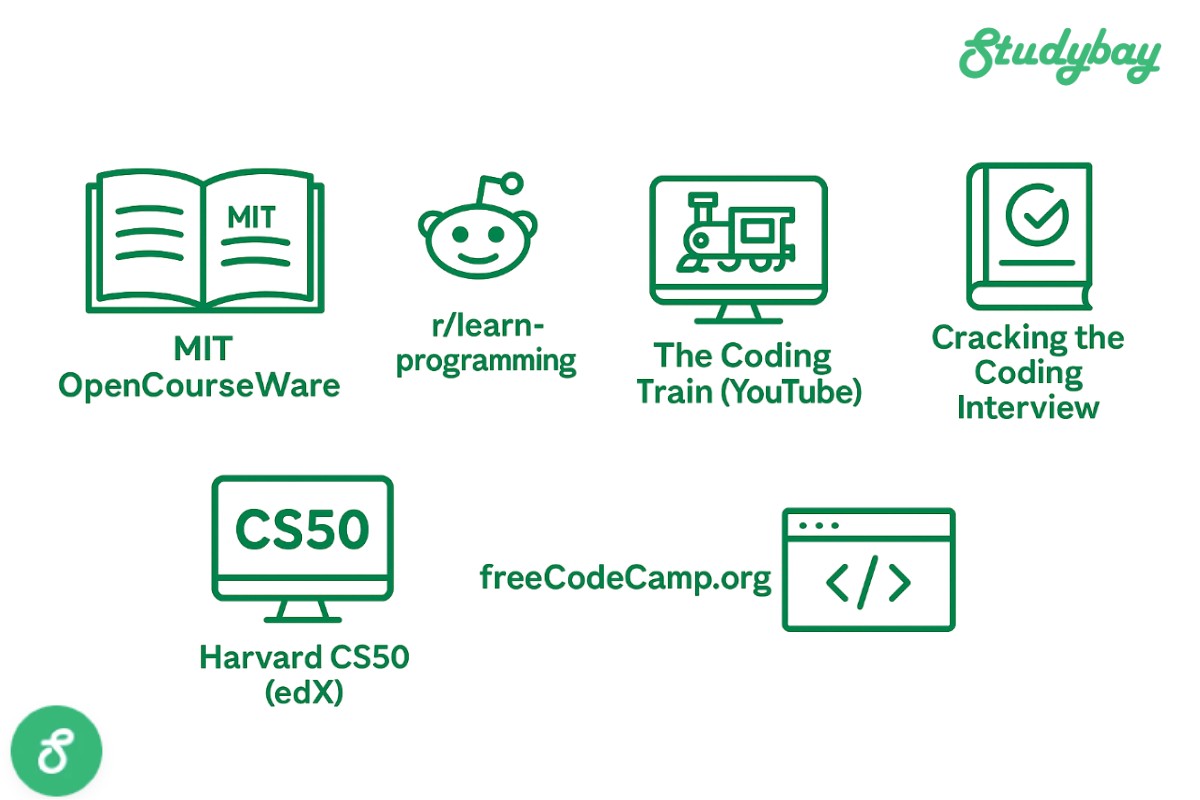
- You may find Harvard's CS50, a free and easy-to-follow introduction to computer science, on edX and YouTube.
- MIT OpenCourseWare (OCW) has textbooks, lectures, and assignments for both undergraduate and graduate students who want to study computer science.
- You need to read Gayle Laakmann McDowell's "Cracking the Coding Interview" to prepare for technical interviews and problem-solving.
- The Coding Train on YouTube has fun, visual coding classes that are perfect for people who learn best by seeing and creative coders.
- r/learnprogramming on Reddit is a well-known area to ask questions and get help with your studies.
- You may take entire online courses in web programming, JavaScript, Python, and other languages at freeCodeCamp.org.
No matter how you learn, there is a resource out there that can help you go forward in your computer science studies.
Frequently Asked Questions

What is the best college for computer science?
Some of the top-ranked U.S. colleges for computer science include MIT, Stanford, Carnegie Mellon, and UC Berkeley. Each excels in areas like AI, cybersecurity, and data science. However, the "best" college depends on factors like your interests, budget, and career goals.
Is computer science hard in college?
Yes, computer science can be challenging. Students often struggle with programming, logic, and math-heavy topics like data structures or algorithms. That said, with persistence and support, most students can succeed—especially those who enjoy puzzles, logic games, and problem-solving.
How many years of college does it take for computer science?
A bachelor's degree in computer science typically takes four years to complete in the U.S. Some students choose to continue with a master’s (1–2 additional years) or PhD depending on their career path.
What do computer science majors do after college?
Graduates work in fields like software development, data science, cybersecurity, UX design, and AI research. Many also pursue roles in finance, healthcare, education, and startups. Career outcomes are generally strong, with high job placement and salaries.
How much do computer science majors make out of college?
Recent statistics show that computer science graduates earn an average of around $119,000 annually. Salaries vary by role, company, and location but are among the highest for new graduates in any field.