

32 min
0
08.27.2025

Key Takeaways
- Choose a topic that fits with your objective, audience, and hobbies.
- Learn the basic structure of a good essay to understand what makes an argument strong.
- Follow step-by-step directions to get from research to a focused thesis and a logical flow of writing.
- Don't make frequent blunders like choosing a theme that has been done too many times or bypassing the research step.
- Look through a lot of different areas, like government, ethics, technology, and education, to find what works best for you.
- Printable topic lists and interactive quizzes might help you come up with ideas.
- Keep in mind that successful writing comes from being prepared, being curious, and knowing what your teacher wants from you.
- Key Takeaways:
- Beginning
- What Is an Argumentative Essay, and Why Is It Important?
- Step by Step, How to Write a Strong Argumentative Essay
- How to Pick the Right Topic for an Argumentative Essay
- Things That Are Popular in the U.S. Assignments for College and Classrooms
- Topics That Are Easy for New Writers to Write About
- Topics for Argumentative Essays About Education
- Topics in Government and Law
- Ethics and Science
- AI and Technology
- Environmental and Climate Issues
- Bioethics and Health
- Families, Parents, and Teens
- Athletics and Sports
- Life on the Internet and on Social Media
- Religion and Life in Public
- Business, Work, and Money
- Topics That Are Debatable but Important
- Current U.S. Events and Policies That Can Be Used as Argumentative Topics
- Topics for Argumentative Essays for AP English, IB, or SAT Prep
- Things Students Do Wrong When Picking Essay Topics
- Topics for Argumentative Speeches
- Questions and Answers (FAQ)
Beginning

You're not the only one who has ever stood in the library aisles or stared at a blank Google Doc and wondered what to write about. It can be hard to choose a topic for an argumentative essay, especially if you need one that is smart, topical, and strong enough to sustain the whole document. This guide will help you with that. We have everything you need to get ready for a class project or the AP English exam, including topic lists, writing hints, and advice that makes sense.
This resource is made just for high school and college students in the U.S. It covers topics that are similar to what is taught in real classrooms, from Common Core requirements to producing research papers at the college level. There are ideas that relate to real-world problems, help you think more critically, and encourage the kind of writing that schools value, which is based on evidence. You're in the proper place if you want to write something that is convincing, insightful, and based on the ideals of education today.
What Is an Argumentative Essay, and Why Is It Important?

An argumentative essay is a style of writing where students take a definite side on a subject and back it up with solid proof and sound reasoning. An argumentative essay is different from a persuasive essay since it doesn't rely on emotion as much. Instead, it uses facts, structure, and well-thought-out arguments. Because it's such a regular project in high school and college, teachers often provide students large lists of argumentative essay ideas to help them get started.
But these pieces are more than just turning in a paper. Argumentative writing helps you learn important academic skills, like how to write a thesis, organize your thoughts, and back up your claims with reliable references. This type of writing is important for college-level work and is used in tests like the SAT essay and the AP English examinations. It also helps children learn how to think critically, which means being able to look at both sides of an issue and come to a logical conclusion.
These essays are a crash course in communication, teaching you everything from how to make an argument to how to back it up with strong evidence. They teach pupils not only how to write, but also why they are writing. Whether you want to study physics, history, or business, learning how to write this way will help you get your ideas across better and make your voice stronger.
Step by Step, How to Write a Strong Argumentative Essay
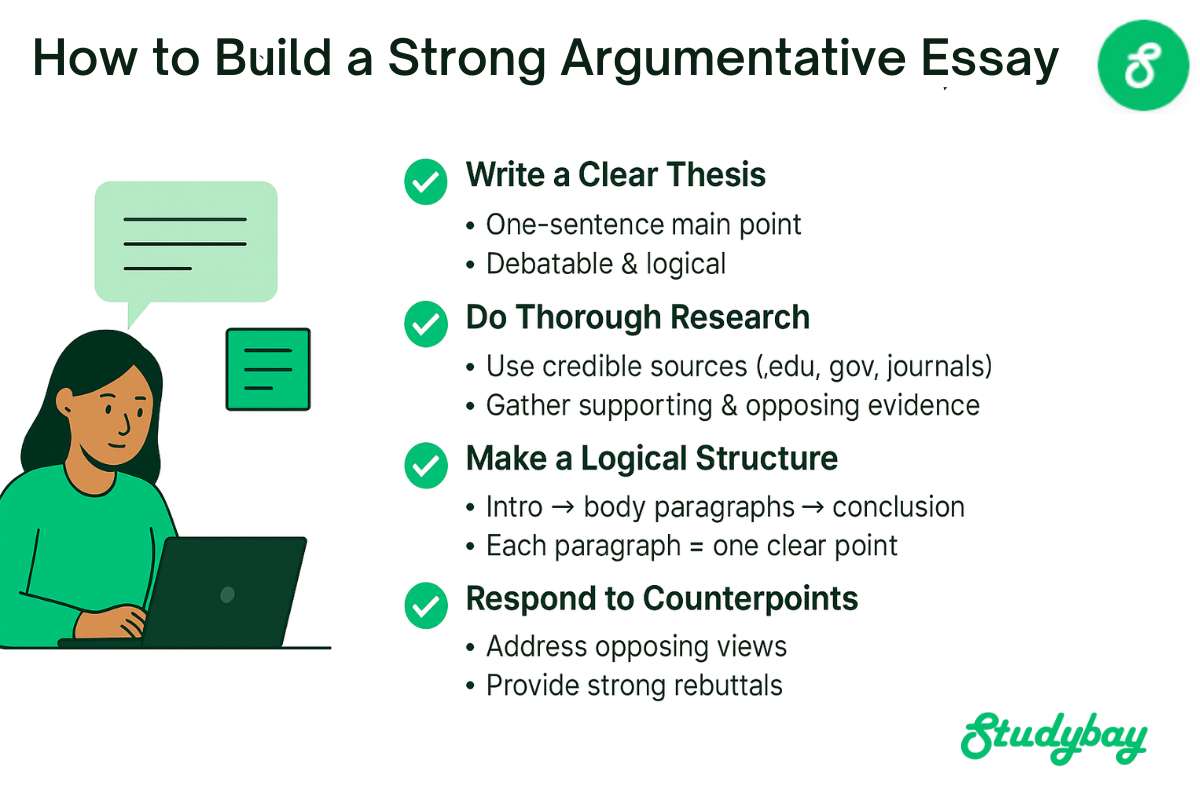
Strong arguing subjects need equally strong essays, and the best ones have a clear, step-by-step framework. Knowing how to do it will make your writing for class or college admissions easier to handle, crisper, and more convincing. Here is how to split it down:
-
Write a Clear Thesis Statement
The key point of your argument is your thesis, which is a one-sentence statement of your main point. Everything else you write in your essay will either support or connect to this. A strong thesis is clear, open to debate, and based on logic. For instance, "Schools should start later to help students' mental health and performance."
-
Do Thorough Research
It's time to start researching once your thesis is set. Find trustworthy sources like academic publications, .edu websites, government reports, or interviews with experts. Write down both the evidence that supports your case and the facts that could go against it. This will help you make arguments that are fair and well-informed.
-
Make a Logical Structure
Plan the framework of your essay with an outline. An introduction, three or more body paragraphs, and a conclusion are all common parts of a format. Each body paragraph should be about one assertion, and it should be backed up by clear logic and detailed examples.
-
Respond to Counterpoints and Rebuttals
A good essay knows what the other side will say. Write at least one paragraph that talks about alternative points of view, and then give thoughtful counterarguments. This shows that you have thought about many points of view and still believe in your theory.
-
Finish with a Strong Conclusion
Finish by going over your main points and making your thesis stronger. The conclusion should give readers one last thought or make them want to think more deeply. Don't add any new points; here is your moment to make your case stick.
If you follow these steps, you'll turn a hard assignment into a well-organized, convincing piece of writing that makes sense and is ready to impress.
How to Pick the Right Topic for an Argumentative Essay
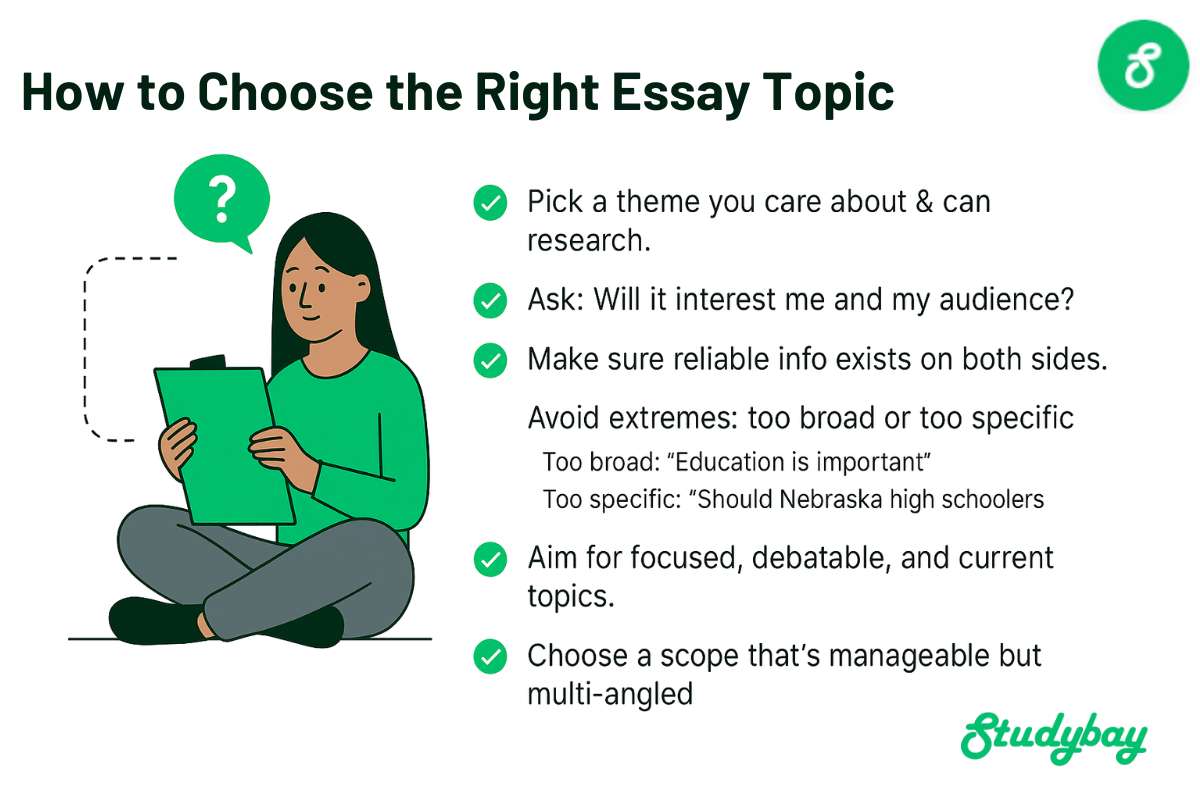
The first step to creating an argumentative essay that you care about and that your readers will care about is to choose the correct themes. A good topic isn't just popular or controversial; it's one that you really care about and can back up with good research. If it has something to do with something you've read in class or talked about with friends, that's even better.
When picking a topic, ask yourself if it makes you curious. Will my audience find it useful? Can I locate enough reliable information to back up all sides of the arguments? Good themes have a clear point and aren't too broad or too specific. For example, "education is important" is too broad, while "should high schoolers in Nebraska learn cursive?" is too specific. For instance, "Should all U.S. students get free college?" is concentrated, up-to-date, and easy to investigate, and it also lets you write in a more nuanced way.
A lot of college students don't think about how the scope of a topic affects how they write their essays. Choose a topic that is wide enough to look at from many angles but narrow enough to fit in a few pages. If you're still not sure, look over your professor's rubric or ask the people in your college debate club for some ideas. They know how to find the right balance.
Things That Are Popular in the U.S. Assignments for College and Classrooms

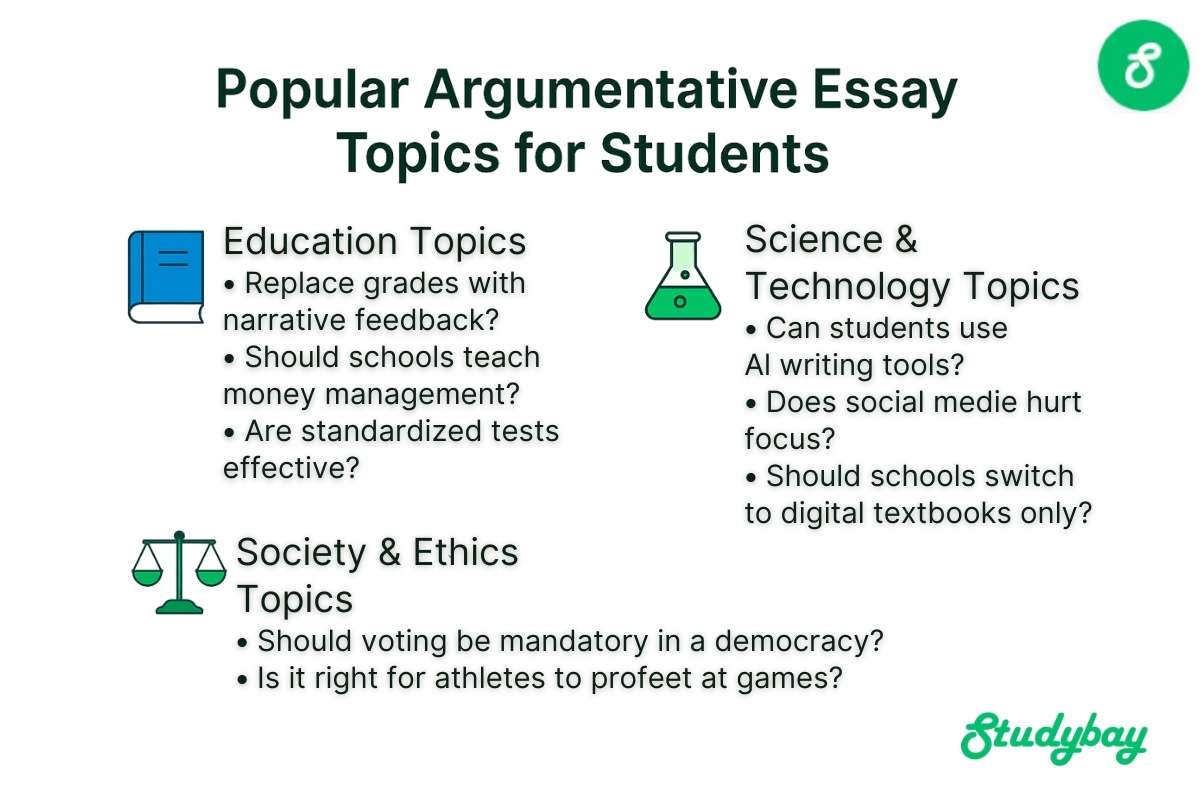
A successful high school argumentative essay generally starts with a topic that comes straight from real classroom conversations. These are the kinds of topics that teachers know will make students think critically, write clearly, and deal with real-world problems. These topics are commonly part of Common Core writing standards or show up in AP and IB writing assignments in the U.S. That means that if you are in a public school or a first-year college writing class, you will probably see at least one of the themes below.
- Teachers love these education topics because they are intimately related to what pupils have been through:
- Should schools get rid of letter grades and use narrative feedback instead?
- Do students need to take classes on how to manage their money?
- Are standardized assessments a good way to see how much someone has learned?
- Science and Technology Topics: Because the world is changing so quickly, students are often given assignments that make them think about the future, such as:
- Should students be able to use AI tools to write in class?
- Is social media making it harder for students to pay attention?
- Should schools use only digital textbooks?
- Society and Ethics Topics: These subjects make you think hard about fairness, identity, and values, which is a big element of the American curriculum:
- Should people in a democratic society have to vote?
- Is it right for athletes to protest during games?
- Is it okay for schools to not allow some books?
These themes don't just test your writing; they also show what people are talking about in American schools. If you pick one that speaks to you, it will be easier to write and more significant to your readers.
Topics That Are Easy for New Writers to Write About
Don't worry if you're new to writing arguments; everyone has to start somewhere. Choosing argumentative essay topics that are easy to understand, relate to, and support with your own experiences is the ideal method to boost your confidence. These subjects are great for middle school and early high school students who are writing for the first time since they help you organize your thoughts without making you feel overwhelmed.
Many schools in the U.S. use introductory prompts to teach pupils how to develop a compelling topic and back it up with reasons. These subjects are from things that happen in school, on social media, or in pop culture. They are perfect for practicing how to adequately explain and defend your beliefs.
Here are some controversial issues that are easy for beginners to understand:
- Do pupils need to do homework every night?
- Is it better to eat lunch outside or in the cafeteria?
- Should video games be a part of school reward systems?
- Should schools not allow energy drinks?
- Is it fair to make middle school students wear uniforms?
- Should students be free to pick where they sit in class?
- Is social media bad or useful for making friends?
- Should school start later in the morning?
- Are pets healthy for youngsters' mental health?
- Should schools put a restriction on how much time pupils can spend on screens?
These basic subjects are a great way to improve your writing because they are both fun and challenging.
Topics for Argumentative Essays About Education

There are a lot of important subjects to talk about in education, from school rules to national reforms. These topics are part of continuing discussions in U.S. schools and colleges, offering students a chance to think about issues that affect their lives now and in the future. These prompts will make you think critically about how schools should change, whether you're writing about learning settings, access to college, or the role of teachers.
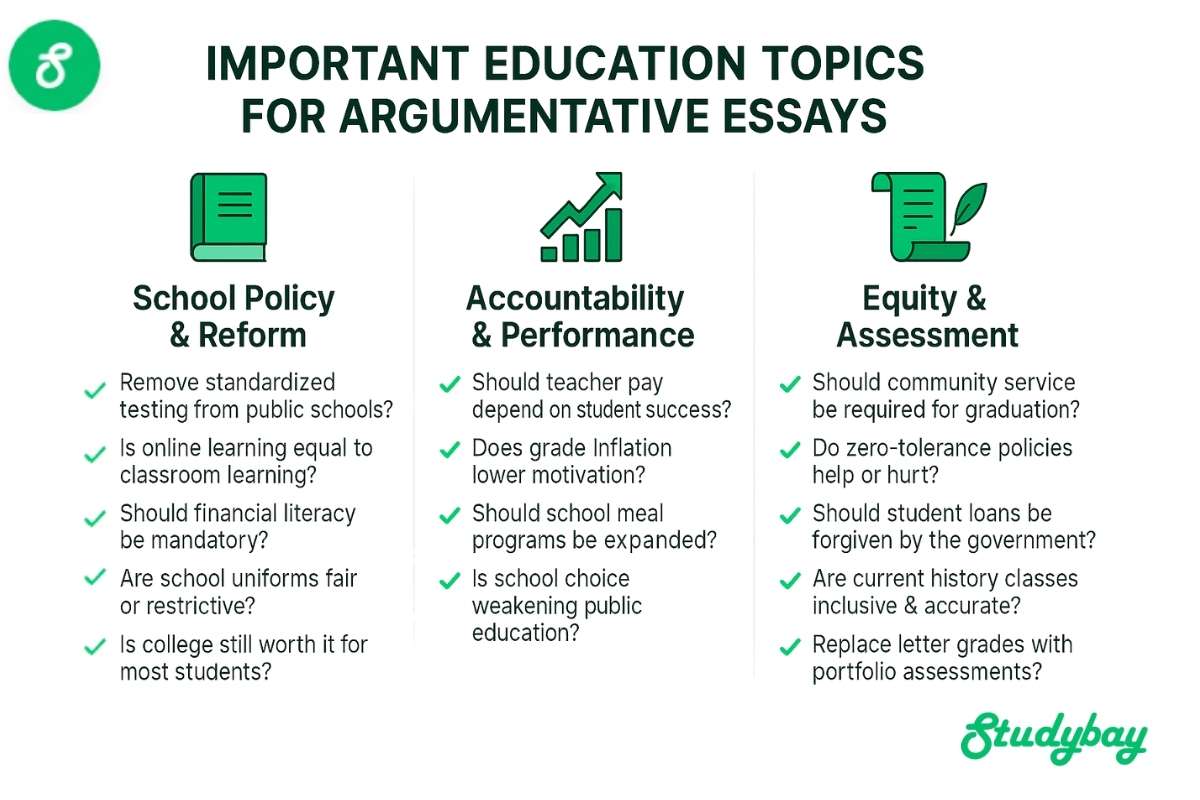

- Should standardized testing be taken out of public schools?
- Is learning online as good as learning in a classroom?
- Should every high school student have to take a class on how to handle money?
- Are school uniforms a way to make things more fair or a way to stop people from expressing themselves?
- Should schools provide equal importance to social-emotional learning and academics?
- Is it worth it for most students nowadays to go to college?
- Should teachers get paid more if their students do well?
- Does grade inflation hurt students' motivation and results in the long run?
- Should school meal programs be made bigger to help kids learn?
- Is the public education system getting weaker because of school choice?
- Should students have to do community service to get their diploma?
- Do policies that don't allow any exceptions assist or damage school discipline?
- Should the federal government cancel loans for students?
- Are the history classes we have now accurate and open to everyone?
- Should schools do away with letter grades and use portfolio assessments instead?
These subjects encourage you to look at the nexus of policy, teaching, and student life, which is where real change begins.
Topics in Government and Law
Law and government are two subjects that get students to talk about things in class more than most. If you're looking at individual rights, public policy, or the justice system, these topics make students think critically about the systems that shape American society. They also show what people are talking about at all levels, from the Supreme Court to city councils. This makes them great for students who are writing about current events and civic duty.
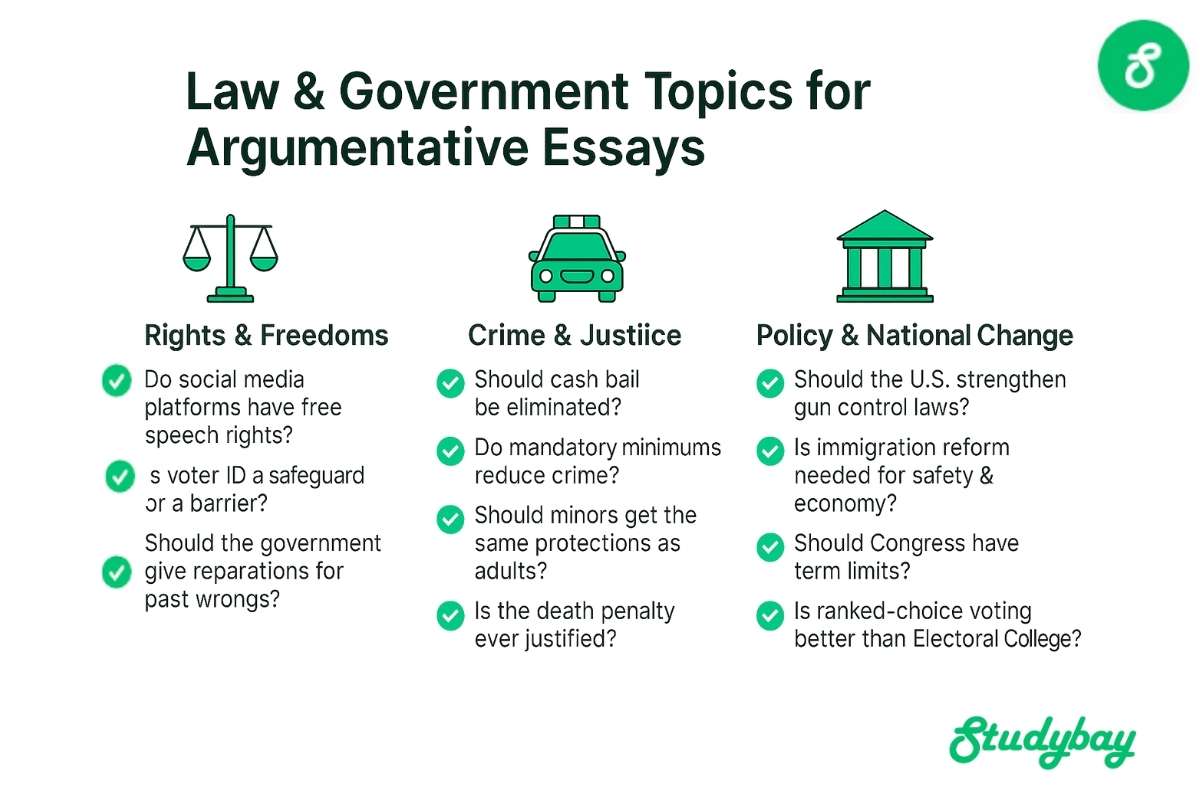
Rights and Freedoms of Citizens
- Do social media sites have the right to free speech?
- Is voter ID legislation a protection or an obstacle to voting rights?
- Should the government pay people back for wrongs done in the past?
- Is it time to change the First Amendment to fit the way things are now that we live in a digital world?
Crime and the Law
- Should cash bail be gotten rid of to make the criminal justice system more fair?
- Do mandatory minimum sentences work to lower crime?
- Should young people who break the law get the same legal protections as adults?
- Is the death penalty ever allowed by the law?
Policy and Change at the National Level
- Should the U.S. have more tight rules around guns?
- Is immigration reform needed to keep the country safe and the economy stable?
- Should the Constitution be changed to limit the number of terms that Congress can serve?
- Is ranked-choice voting a better way to choose a president than the Electoral College?
These themes help students think about difficult concerns that are at the heart of democracy and make room for well-informed, well-thought-out arguments.
Ethics and Science

Science often goes beyond what is possible, but that doesn't mean that all that can be done should be done. That's where morals come in. Students are encouraged to think about how moral responsibility and scientific discovery are related in both high school labs and college research contexts. These issues, like gene editing and environmental danger, have writers think about how to balance facts with morals and long-term effects.
Here are ten science-and-ethics debate themes that will make you think:
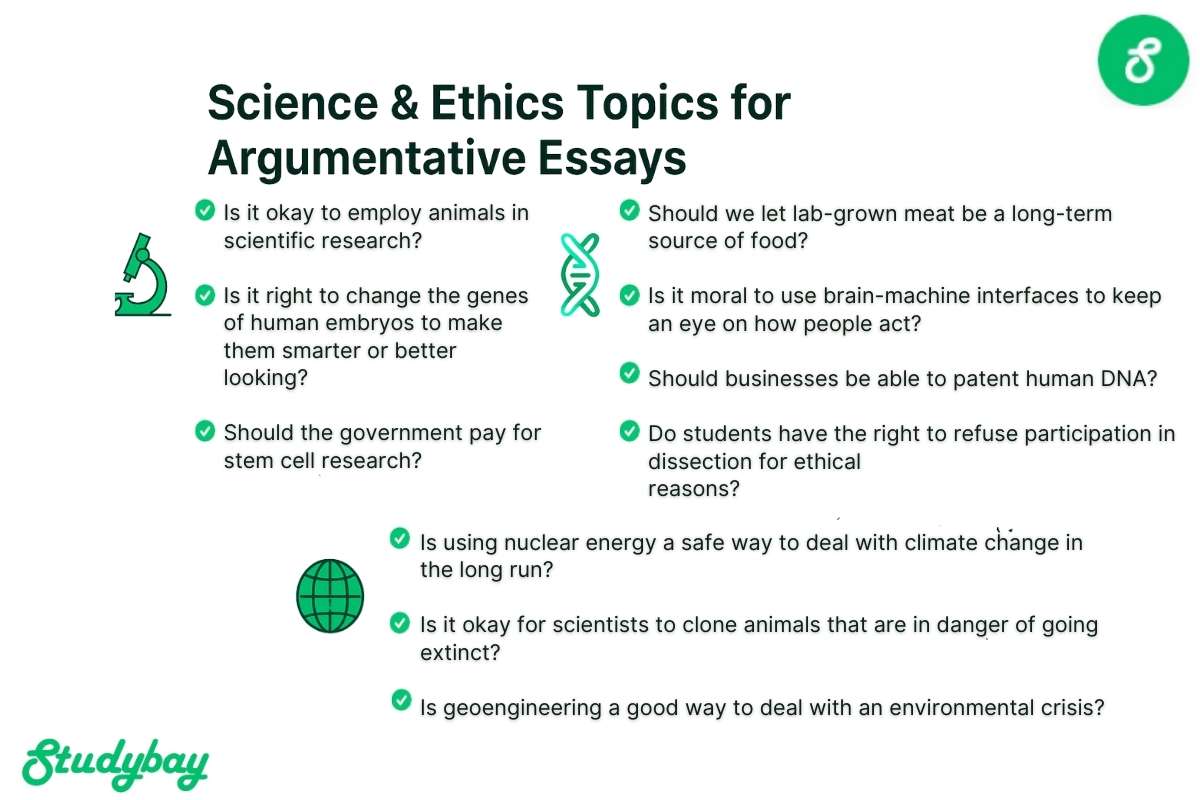
- Is it okay to employ animals in scientific research?
- Is it right to change the genes of human embryos to make them smarter or better looking?
- Should the government pay for stem cell research?
- Is using nuclear energy a safe way to deal with climate change in the long run?
- Is it okay for scientists to clone animals that are in danger of going extinct?
- Is geoengineering a good way to deal with an environmental crisis?
- Should we let lab-grown meat be a long-term source of food?
- Is it moral to use brain-machine interfaces to keep an eye on how people act?
- Should businesses be able to patent human DNA?
- Do students have the right to refuse participation in dissection for ethical reasons?
These subjects integrate scientific literacy with ethical contemplation—crucial competencies for students entering an innovation-driven environment.
AI and Technology

Technology and AI are altering the way we live, learn, and connect. For example, ChatGPT helps with schoolwork and public schools use facial recognition. But with that advancement comes a lot of new moral problems about privacy, false information, justice, and the responsibility of robots in making decisions for people. These tools are changing the society that today's students live in, therefore they are great topics for writing and talking about in class.
Here are 12 current tech-related controversial themes to look into:
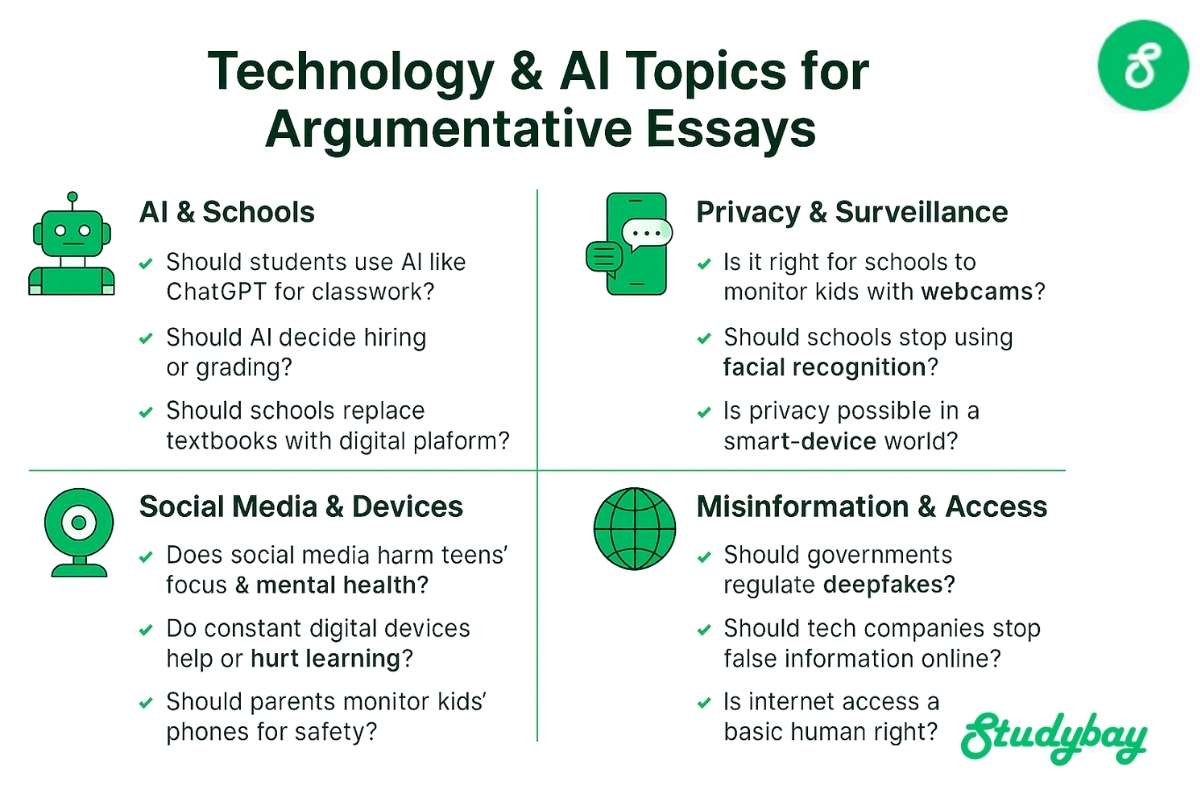
- Should students be able to utilize AI technologies like ChatGPT for classroom work?
- Is it right for schools to keep an eye on children with webcams?
- Should governments see deepfakes as a danger to public confidence and control them?
- Is social media bad for teens' mental health and ability to pay attention?
- Should public schools stop using facial recognition for security and attendance?
- Does having continual access to digital devices assist or damage students' learning?
- Should parents keep an eye on their kids' phones for their own safety?
- Is it still feasible to have privacy in a world full with smart devices?
- Should schools get rid of all textbooks and use only digital platforms?
- Is it the duty of IT corporations to stop false information from spreading online?
- Should AI be able to decide who to hire or grade?
- Is it a basic right for everyone to have access to the internet?
These questions have students think critically about the future and how they may help shape how we use (or limit) technology.
Environmental and Climate Issues

Environmental issues are more important than ever, from beaches that are being eroded by increasing seas to arguments about wind farms in rural areas. Students who are studying science, public policy, or sustainability might look at solutions that are as complicated as the problems. These prompts allow you think about one of the most important issues of our time, whether you're looking into the economics of green energy or the ethics of land use.
Here are 12 subjects for arguments that have to do with the environment and climate:
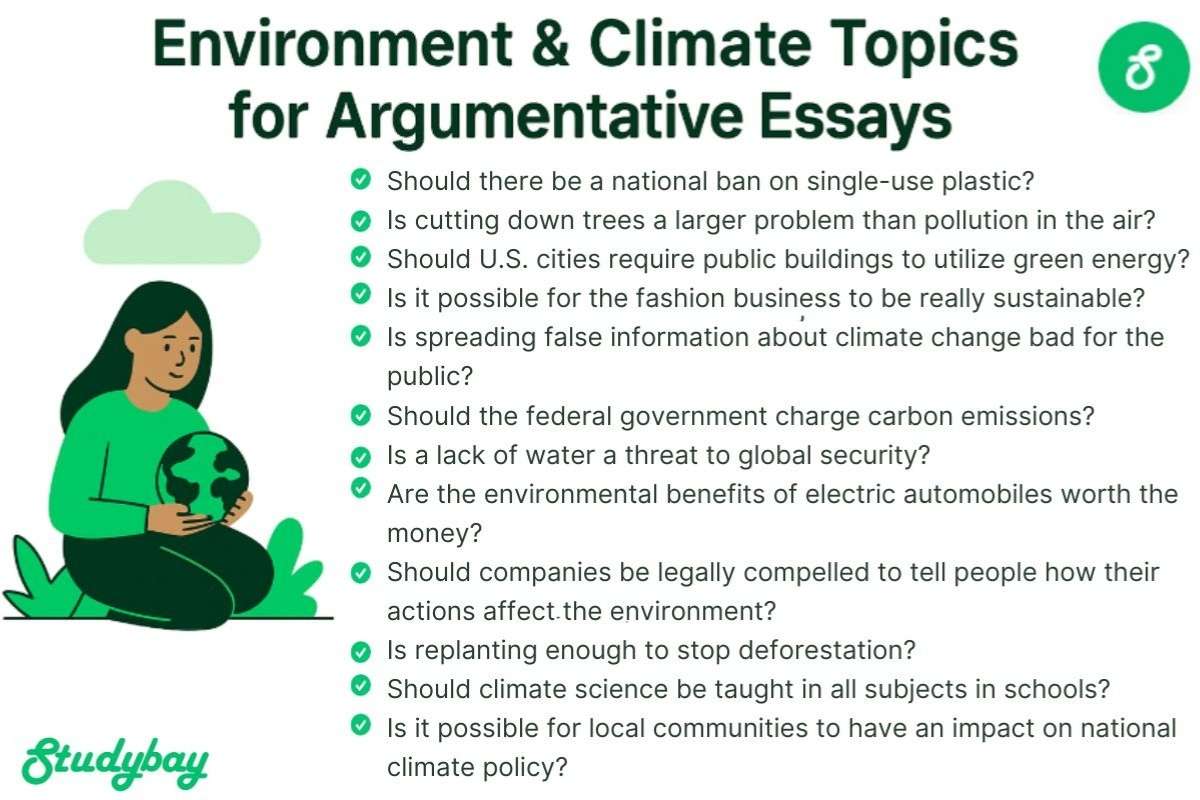
- Should there be a national ban on single-use plastic?
- Is cutting down trees a larger problem than pollution in the air?
- Should U.S. cities require public buildings to utilize green energy?
- Is it possible for the fashion business to be really sustainable?
- Is spreading false information about climate change bad for the public?
- Should the federal government charge carbon emissions?
- Is a lack of water a threat to global security?
- Are the environmental benefits of electric automobiles worth the money?
- Should companies be legally compelled to tell people how their actions affect the environment?
- Is replanting enough to stop deforestation?
- Should climate science be taught in all subjects in schools?
- Is it possible for local communities to have an impact on national climate policy?
These issues require students to not just examine facts but also envision a more sustainable and just future.
Bioethics and Health

Health-related issues, like vaccine mandates and access to mental health care, have become the main topics of classroom discussions in recent years. As more people learn about medical privacy, structural inequity, and ethical treatment, students are being encouraged to think about how science, healthcare, and ethics are related. These themes are a great way to look at both individual rights and group responsibility.
Here are 12 health and bioethics issues to think about:

- Should schools and employers require people to get vaccines?
- Is it a public health issue that people can get mental health care?
- Should the U.S. government pay for health care for everyone?
- Should companies help their employees with their mental health?
- Should all adults be permitted to buy birth control without a prescription?
- Is it right to make insurance more expensive for people who don't take care of themselves?
- Should drug legalization put more emphasis on reducing harm than on punishment?
- Are laws against abortion infringing on reproductive rights?
- Should terminally ill individuals have the right to assisted suicide?
- Is it appropriate to not give someone an organ transplant because of how they live?
- What should schools do to help more young people with their mental health?
- Do ads for prescription drugs provide patients false information about how well they work?
These questions have students think thoroughly about how their own health, the health of their neighborhood, and changing national public health policy are all connected.
Families, Parents, and Teens

There is a lot of disagreement concerning parenting and adolescence, whether you're a student writing your first sociology paper or just interested in how families work nowadays. These problems typically come up at the intersection of personal decision, social pressure, and school policy. This makes them great topics for essays about youth development, psychology, or ordinary life at home.
Here are ten argumentation issues that focus on families and teens:
- Should parents keep an eye on what their kids do on their smartphones?
- Is it effective to limit screen time to help kids behave better and pay attention?
- Should kids be able to make big choices about their gender identification without their parents' permission?
- Is rigorous discipline more detrimental than helpful?
- Should public schools do more to stop bullying that happens outside of school?
- Should kids have more flexibility to choose what they do outside of school?
- Do social media sites need to have safety settings only for teens?
- Is it right to employ GPS monitoring devices to keep an eye on where kids are?
- Should parents be held legally liable for their kids' crimes?
- Does enforcing curfews assist or hurt teens' ability to be independent?
These prompts have students think critically about what their families expect of them and the problems that young people confront today.
Athletics and Sports

In the U.S., sports are more than just things to do after school; they are a big element of school culture, identity, and even future jobs. Debates on fairness, health, and financial justice for athletes have been common in both classrooms and the news, from young leagues to NCAA championships. These subjects make competitive sports a great way to write arguments, whether you're writing about student health or business contracts.
Here are ten sports-related subjects that you can argue about:

- Should collegiate athletes get compensated for their endorsements and performance?
- Are high-contact sports too risky for long-term health?
- To support gender equality, should men's and women's sports get the same amount of media coverage and money?
- Is it right for high schools to remove arts programs in favor of sports that are more competitive?
- Should kids have to keep a particular GPA to stay on school teams?
- Are performance-enhancing drugs ever okay in professional sports?
- Should tackling and other high-impact activities be banned in youth sports?
- Is esports a real sport?
- Should athletes be able to protest during the national anthem without getting in trouble?
- Are the existing rules fair to student athletes in the NCAA?
These topics help students look at real-world problems where competition, education, and personal rights all come together.
Life on the Internet and on Social Media

Teens spend a lot of time online, whether it's TikTok between courses or group conversations that never sleep. But that digital world isn't just fun and games. Students nowadays are dealing with privacy, self-image, and online activism in real time. That's why social media is such a good topic for writing that is focused on arguments. It talks on a lot of things, like mental health, civil rights, and how algorithms affect what we think.
Here are ten things to think about when it comes to social media and digital life:
- Should schools control how much time kids spend in front of screens, or should families be in charge of that?
- Should social media sites be responsible for keeping users from things that make them anxious or depressed?
- Should the same free speech rights that apply to other types of expression also apply to social media content?
- Are teens too dependent on likes and following for validation?
- Should influencers have to say when they are paid to make content?
- Do algorithms make political and social bias worse?
- Should schools teach kids about their privacy rights and digital footprints?
- Is it against online rights to block some users or content?
- Is it right for businesses to use social media data to show adverts to specific people?
- Does social media help social movements or get in the way of actual change?
These subjects make students think critically about the technology they use every day and how it affects their lives outside of school.
Religion and Life in Public

The First Amendment protects freedom of religion and stops the government from setting up or favoring any one faith. However, it isn't always easy to put these safeguards into practice in everyday life. Debates over religion in society still affect courtrooms, classrooms, and civic forums. They affect everything from school rules to public funding to how people express themselves.
Here are ten themes about religion and public life that you can look into:
- Should students be able to pray at public schools during class?
- Are religious symbols allowed in government buildings?
- Should public money or vouchers go to faith-based schools?
- Is it against the law to teach creationism in science classes?
- Should businesses be able to refuse service to people based on their religious beliefs?
- Are religious dress rules allowed at school or work?
- Can government officials talk about their faith in official speeches?
- Should students be able to skip school events that go against their religious beliefs?
- Is it against someone's rights to not allow religious headwear?
- Should public schools have more interfaith education?
These questions provide students a chance to think about how religious freedom, public policy, and civic identity all work together in a society that is very different from their own.
Business, Work, and Money

Money and work already affect your daily life, whether you have a part-time job or are thinking about your future career. The U.S. workforce is changing quickly. New technology, labor movements, and changes in the economy are all causing arguments about jobs, justice, and what companies should do. These subjects allow students to think about how economic systems influence workers, families, and the economy as a whole, as well as what kinds of adjustments can make things fairer.
Here are 12 controversial themes about labor and the economy that you might want to think about:
- Should the federal minimum wage go up to keep up with the cost of living?
- Are occupations that can be done from home just as useful and beneficial as jobs that require you to be in the office?
- Should businesses have to make their internal wage ranges public?
- Is it right for CEOs to make hundreds of times more than their workers?
- Should gig workers, like rideshare drivers, be considered full-time employees?
- Is it possible for universal basic income (UBI) to assist people get out of poverty without making them less likely to work?
- Should businesses keep an eye on how productive their employees are while they work from home?
- Is a four-day workweek a good way to deal with burnout?
- Should all internships pay their workers?
- Do businesses have to help with mental health at work?
- Will AI take away too many jobs or make new ones?
- Should we get rid of tips and pay people a set amount of money?
These subjects mix money issues with moral considerations, which helps students figure out what a fair and functional workplace should look like.
Topics That Are Debatable but Important

Some subjects get people very worked up, and that's why they're worth writing about. Writing on difficult topics in college can help you get better at thinking about other points of view, looking at complicated moral issues, and backing up your point of view with solid proof. But we should always talk about these things with respect, transparency, and an understanding of how deeply they affect people and society.
Here are 12 essay themes that are both contentious and relevant to look into:
Justice and the Law
- Should the death penalty be done away with all around the country?
- Is life without parole a more moral punishment than the death penalty?
Rights and Liberties
- Should schools be able to censor what students say on social media?
- Is cancel culture a way to hold people accountable online or a threat to free speech?
- Should people have the legal right to die with dignity?
Public Health and Social Policy
- Should sex work be authorized and controlled as a public service?
- Are safe injection sites a good idea for public health or a bad idea?
Technology and Art
- Should social media sites have to mark content made by AI?
- Is it right for businesses to sell user data without getting permission first?
Beliefs and Culture
- Should religion be able to affect judgments about national policy?
- Do required diversity trainings work to change people's biases?
These subjects are hard on purpose, but if you argue them carefully and in depth, they can lead to interesting academic discussions.
Current U.S. Events and Policies That Can Be Used as Argumentative Topics

Using real-time headlines can turn a decent paper into a great one. When students write argumentative essays about current events, they learn how to stay informed, analyze critically, and talk about civic issues. These subjects show the changing problems and arguments that are going on right now, especially in schools, courts, and communities in the U.S.
Here are ten essay prompts that are relevant to recent events in the U.S.:
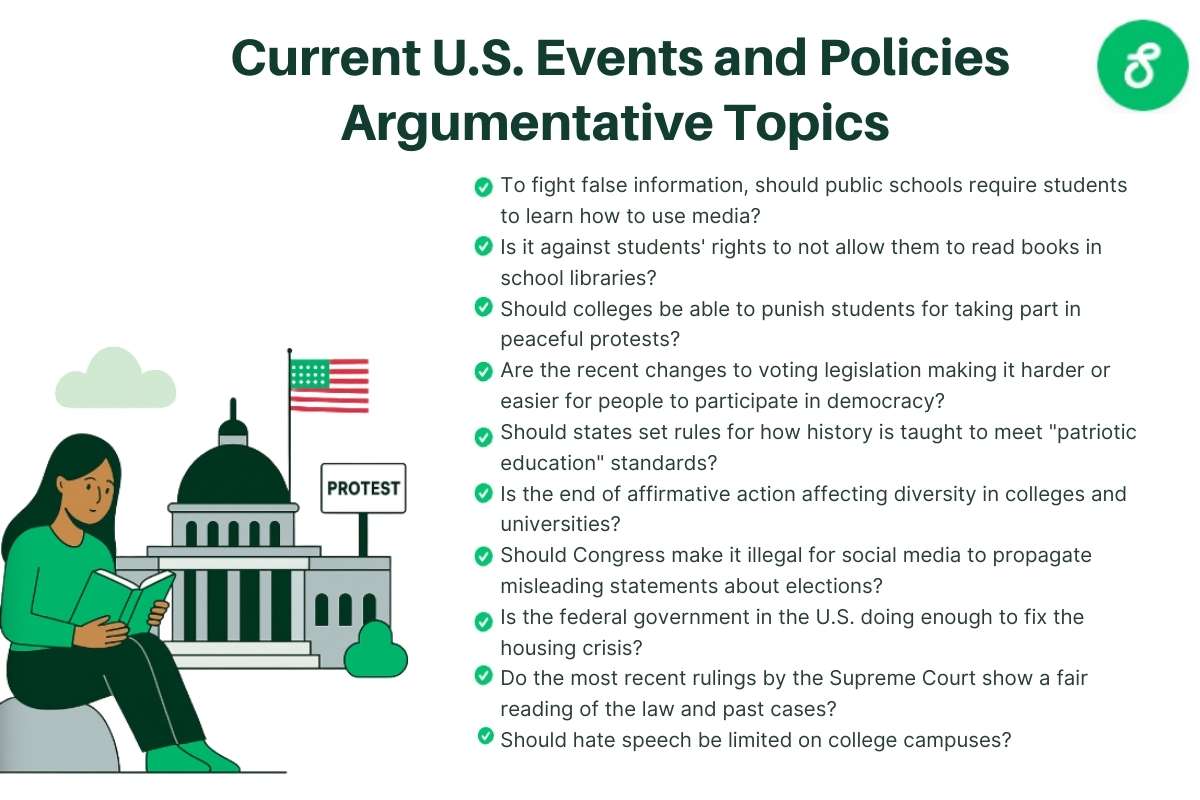
- To fight false information, should public schools require students to learn how to use media?
- Is it against students' rights to not allow them to read books in school libraries?
- Should colleges be able to punish students for taking part in peaceful protests?
- Are the recent changes to voting legislation making it harder or easier for people to participate in democracy?
- Should states set rules for how history is taught to meet "patriotic education" standards?
- Is the end of affirmative action affecting diversity in colleges and universities?
- Should Congress make it illegal for social media to propagate misleading statements about elections?
- Is the federal government in the U.S. doing enough to fix the housing crisis?
- Do the most recent rulings by the Supreme Court show a fair reading of the law and past cases?
- Should hate speech be limited on college campuses?
These themes help students understand how to explore issues that change quickly and how legislation affects the lives of Americans every day.
Topics for Argumentative Essays for AP English, IB, or SAT Prep
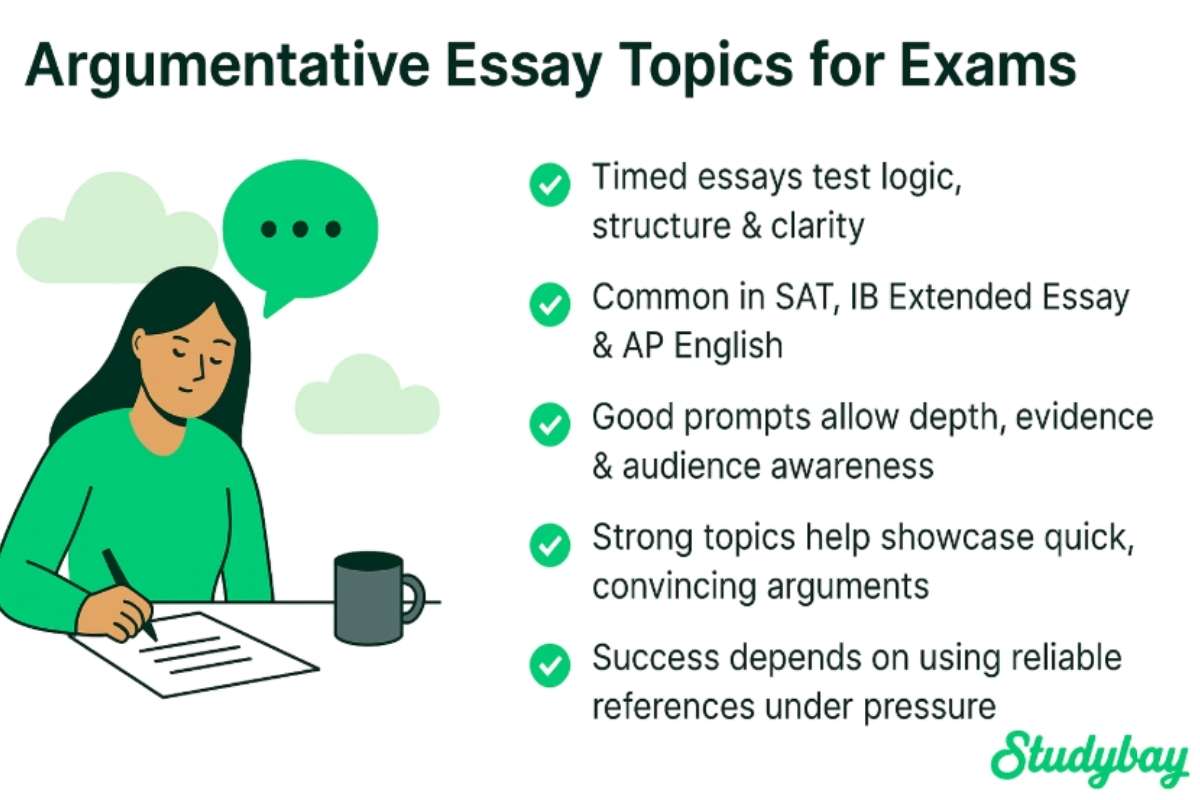
You need to be able to write well to do well on school tests, especially in timed essay parts. Students getting ready for the SAT, the IB Extended Essay, or AP English Language and Composition typically look for good themes for argumentative essays that let them show off their logic, structure, and knowledge of their audience. The finest prompts push students to generate complex arguments, use reliable references, and write convincing essays quickly.
These are 10 exam-style themes that will help you improve your persuasive writing and argument structure:
- Should governments put more money into the arts, even when the economy is bad?
- Is it more necessary to be innovative than to follow tradition in order to be successful in school or work?
- Do standardized examinations test how smart students are or how well they can take tests?
- Is it ever okay to censor things to keep the peace?
- Should colleges look at extracurricular leadership more than GPA when deciding who to accept?
- When celebrities assist social movements, do they gain or lose power?
- Is it possible to be happy in today's academic world?
- Should schools put as much emphasis on emotional intelligence as they do on test scores?
- Is the private sector better at dealing with climate change than governments?
- Is it better to be able to adapt than to know a lot about one thing?
These prompts are just as hard as AP, IB, and SAT writing problems, so they are perfect for students who want to improve their fluency, strategy, and confidence while studying for tests.
Things Students Do Wrong When Picking Essay Topics

Students might ruin even the best argumentative essay ideas if they don't set them up right. A lot of writing center tutors say that essays that aren't working generally start with a poor or misaligned topic—something that's overly broad, not well-researched, or not related to what the audience really cares about. A good essay begins with a topic that is both specific and well-supported.
Here are some frequent mistakes that students make and how to rectify them:
-
Choosing anything too general.
Mistake: "The effect of technology on society."
Fix: Change it to "How AI is changing the way people hire in the U.S."
-
Picking a topic that doesn't interest you much.
Mistake: Writing only to make the teacher happy.
Find a topic that really interests you—your writing will reflect that you're passionate about it.
-
Not paying attention to what your reader needs.
Using inside jokes or specialist references is a mistake.
Fix: Write for an academic audience and presume they don't know anything about your topic.
-
Not doing research.
Mistake: Believing what others say instead of what is true.
Fix: Use reliable sources to back up your thesis and make your points stronger.
If you avoid these mistakes early on, you may focus your topic, make your points stronger, and create a more convincing and relevant essay.
Topics for Argumentative Speeches

Public speaking helps you become more confident, clear, and able to think on your feet, whether it's for a class presentation or a debate tournament. Speech assignments depend a lot on how well you deliver them, how clearly you speak, and how well you get your audience involved. A good speech topic should be easy to understand, touch people's hearts, and be open to many points of view, especially when you are answering questions or making rebuttals.
Here are 12 good subjects for argumentative speeches to think about:
- Should everyone in the U.S. be able to go to college for free?
- Is cancel culture a way for people to hold each other accountable or a type of mob justice?
- Should people have to vote in federal elections?
- Do beauty filters on social media hurt how people see themselves?
- Should there be stronger laws about how to fund political campaigns?
- Is technology that watches students at school a breach of privacy?
- Should athletes have to stand for the national anthem?
- Can playing video games help you think and get along with others?
- Is AI-generated material a danger to jobs that require creativity?
- For the sake of the environment, should we eat less meat?
- Does working from home hurt or enhance workers' productivity?
- Should the age at which people can vote be lowered to 16?
These subjects are excellent for speech contests, persuasive presentations, or in-class debate tasks when engaging the audience is essential.

Questions and Answers (FAQ)
-
What are some decent topics for an argumentative essay?
A good topic should be clear, something you can look up, and something that interests both you and your readers. It should be limited enough to provide a good thesis within your word limit and broad enough to allow for a clear argument with various sides.
-
How can I tell whether a topic is too touchy?
If a topic makes people feel more than it makes them think or makes it hard to have a respectful conversation, it can be too contentious for a classroom. Stick to topics where you can show proof and think about other people's opinions without getting angry.
-
What is the difference between a thesis and a topic?
A topic is what you're writing about, like "screen time and teens." A thesis is what you say about that issue, like "Increased screen time is harming teen mental health by reducing sleep and in-person connection."
-
Is it okay to use topics from lists on the internet?
Yes, but you need to come up with a new angle or rephrase the argument so that it's not just a copy of what has already been said. Adding your own thoughts, ideas, or research can help it stay unique.
-
What if I decide to write about something else halfway through?
It happens! Just be sure to change your thesis, outline, and any evidence you've found so that your framework stays the same. It's okay to change your mind, as long as your final essay still makes a clear, well-supported point.